Originally published on 250 Word Reviews.
DADA WOOF PAPA HOT
(Off-Broadway: Lincoln Center Theater at the Mitzi E. Newhouse)
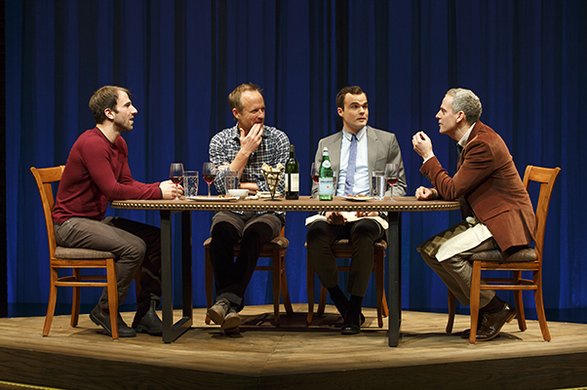
Most gay men of a certain age never envisioned a world in which they could get married and have children. At its surface, Dada Woof Papa Hot examines how two couples-with-toddlers adapt to this reality. But at its heart, Peter Parnell’s play considers whether relationships can survive when partners have radically different ideas of what their partnership should look like. Alan (John Benjamin Hickey) came of age in the pre-AIDS-crisis days of gay sexual liberation but was never much interested in partaking. By 2015, he’s married to Rob (Patrick Breen), who dotes on their daughter and relishes fatherhood – another activity in which Alan has only mild interest. They seek out friendship with younger dads Scott (Stephen Plunkett) and Jason (Alex Hurt), which goes well until Jason and Alan have a tête-à-tête, permitted in the Jason’s relationship but a clear violation on Alan’s part. Alan never wanted kids, Jason never wanted monogamy, and their partners who convinced them into their current arrangements feel betrayed.
As directed by Scott Ellis, the play feels more like a math problem than a drama, with a dose of armchair psychology sprinkled in for flavor. John Lee Beatty’s elaborately modular set is the most interesting thing on stage. Despite strong performances, particularly by Hickey and Plunkett, one gets the sense that neither the characters (beyond Jason) nor the playwright seriously considered that gay people might create and fit into relationships that don’t simply mimic heteronormativity, so the play becomes a straw man argument hardly worth engaging.
Production photo by Joan Marcus. Pictured (l-r): Alex Hurt, John Benjamin Hickey, Stephen Plunkett, and Patrick Breen.



 In 1992, the summer before I started high school, I saw Falsettos on my second-ever trip to Broadway. For those of you unfamiliar with the show, it was the combination of two earlier, ground-breaking off-Broadway musicals by songwriter William Finn: March of the Falsettos, which told the story of Marvin, a Jewish man in his forties who had left his wife and son for a male lover, but who wanted a “tight-knit family” that included all of them; and its sequel, Falsettoland, in which Marvin’s son struggles with becoming bar mitzvah while Marvin’s lover struggles with the disease that would come to be known AIDS.
 David Levy