Fynsworth Alley: Bill Russell

Originally published on Fynsworth Alley.

Bill Russell

Bill Russell

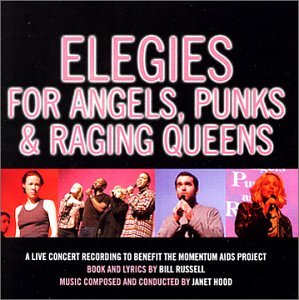
BILL RUSSELL wrote the book and lyrics of Elegies for Angels, Punks and Raging Queens, which he also directed. He’s perhaps best known as the lyricist and bookwriter of Side Show, for which he was nominated for two Tony Awards. He is currently working on Everything’s Ducky and Kept, both with his Side Show collaborator Henry Krieger. His songs appear on the albums Duets, Unsuspecting Hearts, Broadway’s Biggest ’97-’98, Emily Skinner, Haines His Way, and of course, Elegies.

DL: Let’s talk about the show from the beginning. I know you’ve told the story about how you came upon the idea of a Spoon River Anthology about AIDS – what was it about seeing the AIDS Quilt that connected the idea to Spoon River to give birth to Elegies?

BR: I was at the initial unveiling of the quilt in October of 1987, and I was looking for something to do in that free-verse style. I had written poetry in that style for years and years, and shortly after seeing the quilt, I had the idea that I could possibly do a “Spoon River of AIDS.” I was very familiar with Spoon River – I had studied it in high school; I had appeared in it in college; I had directed it also at a summer theatre. All of that came together, and it started out really as an exercise. I just thought I would go where it takes me. I wrote monologues about friends I knew who had either died or who were sick at the time. It went well, and I quickly decided there were theatrical possibilities. I called Janet and asked her if she’d like to write some songs to accompany the monologues, in the way that when Spoon River was adapted for the stage, Charles Aidman incorporated classic American folk songs along with the poems. Using that as a model, that’s what we did.
Continue reading

Fynsworth Alley: Michael Kerker

Originally published on Fynsworth Alley.

MICHAEL KERKER is the Assistant Vice President of ASCAP, the American Society for Composers, Authors, and Performers, serving as ASCAP’s authority on musical theatre and cabaret. He coordinates the ASCAP Musical Theatre Workshop, the Sunday Night Songwriters series at the Firebird Cafe in New York, and other programs to encourage work by emerging and established writers in the musical theatre idiom. He has served on the boards of the Manhattan Association of Cabarets and Clubs, The Johnny Mercer Foundation, The Songwriters’ Hall Of Fame, and The Society of Singers.

DL: Let’s start off talking about your job. For people who have no idea what ASCAP even is, how do you explain it?

MK: To explain what ASCAP is, it’s nice to tell this short story: When Puccini came to America towards the turn of the century for the American premiere of his musical The Girl From The Golden West, he invited the great American composer Victor Herbert to the opening night. When the performance was over, they went to a very famous restaurant in New York on 14th Street called Shanley’s – kind of like the Harmonia Gardens restaurant in Hello, Dolly! Most restaurants at the time had little four-piece orchestras, and when they walked in, because Herbert was the composer of the day, they struck up some Victor Herbert melodies and played them during dinner. Puccini said to Herbert, “Isn’t this wonderful that while we’re dining, you’re earning money?” Herbert didn’t know what he was talking about. Italy had already established a performing rights organization to protect songwriters, to ensure that songwriters would be paid for their music when it was played publicly. Cutting to the chase, Puccini explained what this performing rights society was like, and thus Herbert got the idea that the United States needed an organization comprised of songwriters so that songwriters would be paid when their songs were performed publicly. That’s what ASCAP is. Herbert started it, and the story goes that in 1913, he invited the major songwriters of the day to a meeting. The meeting was held at Luchow’s on West 14th Street, another very famous restaurant. Because the weather was so bad, only eight people showed up! So those eight, plus Victor Herbert are the nine founding fathers of ASCAP. Of interest to your readers, one of the people who showed up was John Golden, for whom the Golden Theatre on Broadway is named; he wrote the song “Poor Butterfly.”

Essentially, what ASCAP does – any place you hear music performed, and that can be bars, grills, restaurants, nightclubs, radio stations, bowling alleys, airports, radio stations, television stations… ASCAP licenses the rights to use music. All that money in turn goes back to the songwriters in the form of royalties. It’s a very complicated system as to how it goes back to the writers, so I won’t go into it now, but that’s essentially what ASCAP does and how it got started.
Continue reading

Fynsworth Alley: Terry Trotter

Originally published on Fynsworth Alley.


Terry Trotter

Terry Trotter

TERRY TROTTER is one of Fynsworth Alley’s most prolific recording artists, mostly as the arranger and pianist of The Trotter Trio, the jazz combo famous for its Sondheim in Jazz series, which includes Passion, Sweeney Todd, Company, A Funny Thing Happened On The Way To The Forum, A Little Night Music, and Follies. Most recently, the trio ventured off-Broadway for their jazz rendering of The Fantasticks.

DL: Let’s start talking about how you began playing piano.

TT: My mom is a wonderful classical pianist, so when I was about four years old I started messing around with the piano to see if I had some talent. I started studying when I was four. My mom didn’t teach me, but she sat with me every day. I had to practice every day from the time I was four until I left high school. Of course, by the time I was thirteen, I wanted to practice, you couldn’t get me away from the piano. Before that, I had to do a certain amount in the morning and a certain amount in the night – I practiced a lot, every day including Christmas and New Year’s. I had a one-week vacation every year where I couldn’t physically get to a piano, but the rest of the year, I had to practice or suffer the consequences.

DL: How did you move into the jazz world?

TT: When I was about twelve, my mom could see that my interest was not as strong as it had been. I heard some jazz music, and she decided to let me go away from the classical for a while. I got really interested in the jazz music, but in classical music also. I studied jazz for about two years and then went back to classical and studied for another ten years with great teachers including Victor Aller, Joseph Levine, and Leonid Hambro who used to travel with Victor Borge as his second pianist. He was also the orchestra pianist for the New York Philharmonic under Leonard Bernstein.
Continue reading

Fynsworth Alley: Guy Haines

Originally published on Fynsworth Alley.

The enigmatic Guy Haines has finally burst forth from simply being one of our repertory singers, finally releasing his very own solo album, Haines His Way. For more information on Guy’s history and background, you can read this interview from last June.

Guy HainesDL: How did you first meet Bruce Kimmel?

GH: Well, let’s see… How does anyone first meet Bruce Kimmel? He just sort of shows up and insinuates himself into your life and then he never leaves. We’ve been friends for as long as I can remember, ever since we were young boys. We used to sing show tunes together and do performances for our parents. One of our great successes was the two of us doing the entire “Dance At The Gym” from West Side Story. Amazing, really, as neither one of us can dance a whit.

DL: Bruce Kimmel has mentioned that your first appearance on one of his albums [Unsung Musicals] was a happy turn of fate involving another singer’s inability to record. How did Bruce approach you for the album? Did you have any time to learn the song? Do you have any idea why he asked you to step in rather than someone with Broadway credits?

GH: Well, that is an interesting story. I guess the original singer of “Her Laughter In My Life” was not feeling well during the sessions and was having vocal problems. I know that Bruce tried to put together a usable vocal out of the ten takes he did, but it just wasn’t working. I happened to be visiting the studio when all this was happening and finally, in desperation, he turned to me and asked me if I’d do a new vocal. Since the song only has a range of about five or six notes I felt comfortable doing it and besides I’d been hearing the thing for three hours in a row and it was already in my head. I’m sure he would have preferred someone with Broadway credits, but frankly I was the only game in town. Continue reading

Fynsworth Alley: 10 Questions with Doug Haverty

Originally published on Fynsworth Alley.

10 Questions with Doug Haverty

Doug Haverty is a graphic designer and playwright. He’s designed many Fynsworth Alley albums, including Cole Porter’s You Never Know, The Stephen Sondheim Album, and Brent Barrett’s Kander and Ebb Album.

inside outYou are both a graphic designer and a songwriter. Which did you get involved with first, and do the two world ever meet?

I started writing plays in high school. I started doing graphics in college. The two worlds met occasionally when I designed flyers for my own plays, but they really merged when I art directed the CD package for my musical (written with Adryan Russ), the Off-Broadway/Cherry Lane Cast Recording of “Inside Out” with Ann Crumb, Kathleen Mahoney-Bennett, Harriett D. Foy, Jan Maxwell, Cass Morgan and Julie Prosser.

Continue reading

Fynsworth Alley: Angels, Punks, and Raging Queens

Originally published on Fynsworth Alley.

Elegies for Angels, Punks, and Raging QueensI’m sure that many of the people involved in last night’s benefit performance of Elegies for Angels, Punks, and Raging Queens looked on the event as a once-in-a-lifetime experience. Not me. I hope this is but the first of many future projects that I’ll be able to take part in that bring together so many talents for the purpose of making a statement about the values of our community, and to benefit those in need of some extra help. Clearly, this was not your run-of-the-mill benefit performance. I’m willing to bet that almost everyone involved in the show has been touched in some way by the AIDS epidemic, but the real point of coalescence for me was that our performance not only raised money for AIDS-related care, but the content of the performance itself paid tribute to those who have gone, those who survive, and those who support. Powerful stuff. During the dress rehearsal, when I heard most of the monologues for the first time, I was brought to tears countless times… the elderly lady who contracted HIV through a transfusion and learns to overcome her own prejudice to die with grace alongside a drag queen… the couple whose families are incredibly supportive until the first partner dies… the street punk drug user who finds an unlikely friend in a gay social worker… and on and on. The songs have never sounded better, surely, but I hope the final album product will be able to convey at least a taste of the scope of this work – gay, straight, bisexual, nonsexual, black, white, Latino, old, young, and unborn AIDS deaths.  Continue reading

Fynsworth Alley: Tom Jones (Part One)

Originally published on Fynsworth Alley.

Tom JonesTom Jones is the book-and-lyrics half of the team that created The Fantasticks, 110 in the Shade, I Do! I Do!, Celebration, Philemon, Colette Collage, and more.

DL: Let’s start right at the beginning. Before you met Harvey Schmidt, what were you doing? How did you guys get to know each other?

TJ: We were both students at the University of Texas. I was studying drama, studying to be a director, not a writer. Harvey was studying to be a commercial artist, as he eventually became very successfully, as I’m sure you must know. I tried to make as much money as I could by picking up directing jobs, directing the melodrama at the local civic theatre, so forth and so on. But there was the annual college musical, put on by the fraternity connected with the journalism department to raise money. They paid the director, and they paid a very modest fee for the book and score. I got the job directing it, and the scripts that I got and the songs that were sent to me were so terrible that I contacted Harvey, whom I knew through a group called the Curtain Club, and I said, “Look, would you like to write an original musical with me? We’ll write it in three weeks or so, and it will be put on a month after that.” He said yes, and we did.

DL: What was it about Harvey that he was the one who sprang to mind?

TJ: Well, he played the piano. And he also composed. The organization we belonged to called the Curtain Club had just done a revue called Hipsy-Boo! (That’s Hipsy-hyphen-boo-exlamation point.) in which some girls in little pants and mesh stockings and bras came out on a runway… actually, it was a revue of American popular theatre music from 1900 to 1950, it took place in 1950. Harvey arranged music from all of these different periods of time, and played it. And he also wrote an original piece of music called “Hipsy-Boo!” – a wonderful, terrific, sensational, sleazy piece of music. I loved it so much. I was connected to the show writing and directing the comedy material involved. That’s how I met him and knew his talents as a composer, really just through that one song. Continue reading

Fynsworth Alley: Musiography – Jason Graae

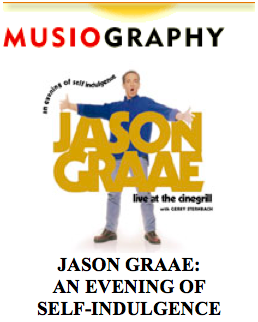
Musiography - Jason GraaeWe receive dozens of customer e-mails each week asking about the origins of songs on our albums, so we thought it would be fun to occasionally devote a column to analyzing the selections on our albums. This week, we’re kicking off the series with Jason Graae’s Evening of Self-Indulgence

But Alive / I’d Be Surprisingly Good For You
Since most everyone knows each of these songs (the former from Strouse and Adams’ Applause, the latter from Lloyd Webber and Rice’s Evita), we decided to ask Jason how he decided to combine the two into an unlikely medley. “Well, I already knew the words to ‘But Alive’, but it was too short, so I figured I ought to add something else,” says Graae, “But actually, it was [director] Heather Lee’s idea to put in ‘I’d Be Surprisingly Good For You’. That was her only contribution to my act.” Continue reading

Fynsworth Alley: 10 Questions with Patrick Brady

Originally published on Fynsworth Alley.

What exactly do you do in your role as Musical Director for a new Broadway show like The Producers?

On The Producers, we have a musical supervisor, Glen Kelly, who created all the piano and dance arrangements and has been working closely with Mel Brooks for the last two years. I have written the vocal arrangements for The Producers and serve as musical director and conductor. My job has been to help cast the show, choose a drummer and assistant conductor, rehearse and teach the music, find the best keys and tempos, prepare the orchestra, make sure the orchestration is correct, conduct seven shows a week, watch the eighth show, give notes to the cast and keep the understudies prepared.

How did you become a Musical Director?

I’ve been accompanying singers, dancers and instrumentalists from the fourth grade on… I’ve played for Christmas pageants, children’s theatre, high school choruses, gymnastics, magic acts, dance classes, voice lessons, auditions, churches, community theatre, college degree recitals, summer stock, private parties, dinner theatre, rock ‘n’ roll bands, cabaret acts, night clubs… it’s too scary to think about… anyway, often the piano player ends up as the leader of the band and that’s what happened in my case.   Continue reading

Fynsworth Alley: Debbie Gravitte

Originally published on Fynsworth Alley.

Debbie GravitteDebbie Gravitte’s association with Bruce Kimmel extends back twenty-five years to The First Nudie Musical, in which Debbie’s voice is heard (although she’s never seen) on several of the songs. Since then, Debbie has gone on to become a Tony-Award-winning Broadway star, appearing in They’re Playing Our Song, Zorba, Blues in the Night, Perfectly Frank, Ain’t Broadway Grand and, of course, Jerome Robbins’ Broadway, for which she won her Tony. Debbie is also a star of the concert stage, having appeared in the Encores productions of Tenderloin and The Boys From Syracuse, as well as concert versions of shows, including Louisiana Purchase and Billion Dollar Baby in other venues. She has toured extensively with her cabaret act, and is currently appearing with Stephen Schwartz in an evening of his songs. She has appeared on many Fynsworth Alley albums, including two of her own: The Alan Menken Album and The MGM Album. You can visit her on the web at DebbieGravitte.com.

DL: Let’s start with your start. How did you get started in show business?

DG: Oh, it’s going to be one of those kinds of interviews? Well, I always loved to sing, and I was always loud. I started doing shows in school. The musical theatre department at my high school had been not happening, and for some reason the year I started high school, they started it again. But my first big thing really was this: When I was a teenager, I auditioned for the LA Civic Light Opera. They were doing Annie Get Your Gun starring Debbie Reynolds, directed by Gower Champion. It was Debbie Reynolds, Harve Presnell and Gavin MacCleod. I did that, and Gower Champion loved me! He wrote me a part, and we went on tour for a month. They wanted to bring it to New York, so I would have made my Broadway debut in that, but Debbie Reynolds was all flipped out because she had just opened at the Minskoff or something, or she was doing her act, and she bombed in New York, so she didn’t want to go back to the city.

That was great, though – the first director I professionally worked with was Gower Champion! One of the greatest! I did that, and in the process of that, I met a man named Tony Stevens, who was the co-choreographer. And the music director was a man named Jack Lee. And they said to me, “Debbie, we’re doing a show in New York, why don’t you come and audition (hint, hint).” I didn’t know what they were talking about, of course, but they meant if I came to New York I would get the show. So of course I flew to New York, I auditioned for the show, and I got it – it was a show called Spotlight. I’m trying to think if there was anything really incredible about it. No. It starred Gene Barry and I understudied the lead. It would be one of two times I understudied in my career – the other time was They’re Playing Our Song. Anyway, the show bombed in Washington, DC. I came back to LA, actually, because I’m born and raised in Los Angeles – for those readers out there who don’t know that, who think I’m a New Yorker because LA has spurned me. Anyway, I came back to LA, and then through James Mitchell, who also worked on Annie Get Your Gun, I got set up with an agent in New York who ended up signing me. A man named Bruce Aven, who was really one of the great agents. When I walked in his office, he said, “I’m going to take you on, but it’s going to take a while for your talents.” He knew I was never an ingénue, which is why I got to be a big slutty girl in The First Nudie Musical. And to answer the question of why I wasn’t actually in the movie [Debbie is heard but not seen], I was probably too young and not pretty enough. At the time.
Continue reading