Fynsworth Alley: Rebecca Luker

Originally published on Fynsworth Alley.
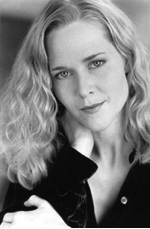
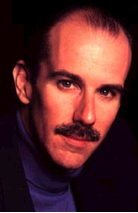
Rebecca Luker

Rebecca Luker

REBECCA LUKER is currently starring in The Music Man on Broadway. She has also starred in The Sound Of Music, Show Boat, The Secret Garden, and The Phantom of the Opera on Broadway, and she can be heard on her Fynsworth Alley cd, Anything Goes: Rebecca Luker sings Cole Porter.

DL: You’re from Alabama, and I understand you were recently inducted into the Hall of Fame there. What’s that about?

RL: Paul Luney started this whole thing three years ago, down in Tuscaloosa. He just wanted to honor Alabamians that had done something in the arts. I am very, very honored, because the night I was honored this past March, To Kill A Mockingbird was also being honored, and Truman Capote was also being honored. I was flattered to death. It was a lovely ceremony. I’m still not sure why it happened, but I’m very, very honored that it did, and now I’m on a plaque on a wall at a Tuscaloosa college, and I have a plaque on my coffee table. It’s very sweet. It was just a lovely night.

DL: When you grew up there, were you involved in theatre and the arts in the community?

RL: Certainly as a young child I was not at all. I sang at church, at school, and in various groups, but we weren’t theatre-going people. There wasn’t much to see around there. I saw the occasional children’s theatre, but there just wasn’t time for that. It wasn’t part of our culture. As I grew up, I began to watch movie musicals when I could, but I still was very removed from that world.
Continue reading
Fynsworth Alley: Bill Russell

Originally published on Fynsworth Alley.

Bill Russell

Bill Russell

BILL RUSSELL wrote the book and lyrics of Elegies for Angels, Punks and Raging Queens, which he also directed. He’s perhaps best known as the lyricist and bookwriter of Side Show, for which he was nominated for two Tony Awards. He is currently working on Everything’s Ducky and Kept, both with his Side Show collaborator Henry Krieger. His songs appear on the albums Duets, Unsuspecting Hearts, Broadway’s Biggest ’97-’98, Emily Skinner, Haines His Way, and of course, Elegies.

DL: Let’s talk about the show from the beginning. I know you’ve told the story about how you came upon the idea of a Spoon River Anthology about AIDS – what was it about seeing the AIDS Quilt that connected the idea to Spoon River to give birth to Elegies?

BR: I was at the initial unveiling of the quilt in October of 1987, and I was looking for something to do in that free-verse style. I had written poetry in that style for years and years, and shortly after seeing the quilt, I had the idea that I could possibly do a “Spoon River of AIDS.” I was very familiar with Spoon River – I had studied it in high school; I had appeared in it in college; I had directed it also at a summer theatre. All of that came together, and it started out really as an exercise. I just thought I would go where it takes me. I wrote monologues about friends I knew who had either died or who were sick at the time. It went well, and I quickly decided there were theatrical possibilities. I called Janet and asked her if she’d like to write some songs to accompany the monologues, in the way that when Spoon River was adapted for the stage, Charles Aidman incorporated classic American folk songs along with the poems. Using that as a model, that’s what we did.
Continue reading

Fynsworth Alley: Michael Kerker

Originally published on Fynsworth Alley.

MICHAEL KERKER is the Assistant Vice President of ASCAP, the American Society for Composers, Authors, and Performers, serving as ASCAP’s authority on musical theatre and cabaret. He coordinates the ASCAP Musical Theatre Workshop, the Sunday Night Songwriters series at the Firebird Cafe in New York, and other programs to encourage work by emerging and established writers in the musical theatre idiom. He has served on the boards of the Manhattan Association of Cabarets and Clubs, The Johnny Mercer Foundation, The Songwriters’ Hall Of Fame, and The Society of Singers.

DL: Let’s start off talking about your job. For people who have no idea what ASCAP even is, how do you explain it?

MK: To explain what ASCAP is, it’s nice to tell this short story: When Puccini came to America towards the turn of the century for the American premiere of his musical The Girl From The Golden West, he invited the great American composer Victor Herbert to the opening night. When the performance was over, they went to a very famous restaurant in New York on 14th Street called Shanley’s – kind of like the Harmonia Gardens restaurant in Hello, Dolly! Most restaurants at the time had little four-piece orchestras, and when they walked in, because Herbert was the composer of the day, they struck up some Victor Herbert melodies and played them during dinner. Puccini said to Herbert, “Isn’t this wonderful that while we’re dining, you’re earning money?” Herbert didn’t know what he was talking about. Italy had already established a performing rights organization to protect songwriters, to ensure that songwriters would be paid for their music when it was played publicly. Cutting to the chase, Puccini explained what this performing rights society was like, and thus Herbert got the idea that the United States needed an organization comprised of songwriters so that songwriters would be paid when their songs were performed publicly. That’s what ASCAP is. Herbert started it, and the story goes that in 1913, he invited the major songwriters of the day to a meeting. The meeting was held at Luchow’s on West 14th Street, another very famous restaurant. Because the weather was so bad, only eight people showed up! So those eight, plus Victor Herbert are the nine founding fathers of ASCAP. Of interest to your readers, one of the people who showed up was John Golden, for whom the Golden Theatre on Broadway is named; he wrote the song “Poor Butterfly.”

Essentially, what ASCAP does – any place you hear music performed, and that can be bars, grills, restaurants, nightclubs, radio stations, bowling alleys, airports, radio stations, television stations… ASCAP licenses the rights to use music. All that money in turn goes back to the songwriters in the form of royalties. It’s a very complicated system as to how it goes back to the writers, so I won’t go into it now, but that’s essentially what ASCAP does and how it got started.
Continue reading

Fynsworth Alley: Terry Trotter

Originally published on Fynsworth Alley.


Terry Trotter

Terry Trotter

TERRY TROTTER is one of Fynsworth Alley’s most prolific recording artists, mostly as the arranger and pianist of The Trotter Trio, the jazz combo famous for its Sondheim in Jazz series, which includes Passion, Sweeney Todd, Company, A Funny Thing Happened On The Way To The Forum, A Little Night Music, and Follies. Most recently, the trio ventured off-Broadway for their jazz rendering of The Fantasticks.

DL: Let’s start talking about how you began playing piano.

TT: My mom is a wonderful classical pianist, so when I was about four years old I started messing around with the piano to see if I had some talent. I started studying when I was four. My mom didn’t teach me, but she sat with me every day. I had to practice every day from the time I was four until I left high school. Of course, by the time I was thirteen, I wanted to practice, you couldn’t get me away from the piano. Before that, I had to do a certain amount in the morning and a certain amount in the night – I practiced a lot, every day including Christmas and New Year’s. I had a one-week vacation every year where I couldn’t physically get to a piano, but the rest of the year, I had to practice or suffer the consequences.

DL: How did you move into the jazz world?

TT: When I was about twelve, my mom could see that my interest was not as strong as it had been. I heard some jazz music, and she decided to let me go away from the classical for a while. I got really interested in the jazz music, but in classical music also. I studied jazz for about two years and then went back to classical and studied for another ten years with great teachers including Victor Aller, Joseph Levine, and Leonid Hambro who used to travel with Victor Borge as his second pianist. He was also the orchestra pianist for the New York Philharmonic under Leonard Bernstein.
Continue reading

Fynsworth Alley: Victoria Maxwell

Originally published on Fynsworth Alley.

Victoria Maxwell is one-third of the Momentum Productions, the producers of Bells Are Ringing. What’s more, Victoria is one of the last of an endangered breed — the independent producer on Broadway. In an industry that seems to be dominated by corporate producers like Disney and SFX, Victoria has carved out a successful career putting on shows as diverse as Damn Yankees, Jeffrey, Stomp, Play On!, The Most Fabulous Story Ever Told, and last year’s Pulitzer Prize winner, Dinner With Friends.

DL: How did you get involved in producing?

VM: Well, I’m partners with my brother, Mitchell Maxwell. He’s eleven years older than I am, and he was producing plays. He produced his first play in New York when he was 21. Then he directed in England, and soon he was producing more plays. In 1984, he was producing a wonderful play called To Gillian on Her 37th Birthday, which starred Sarah Jessica Parker, Cheryl McFadden, and David Rasche. I was working at the Writers and Artists Agency as sort of an interim receptionist; it was not really a very fun job, but both the writer and the director on that project were represented by the Writers and Artists Agency. So, I had already read the contracts, I had already seen the play. So when they were staffing the show to move it from the Ensemble Studio Theatre to an off-Broadway theatre, I said to my brother, “You have to hire production assistants for the show anyway. I’ve already read the contracts and seen the project, why don’t you try me?” And I did really well – I did everything! I threw the opening night party, I closed the partnership, I spoke to all the investors… I was a one-man-band. I realized that it was really fun and really exciting. There was always a fire to put out, there was always someone to talk to, and then the thing that made it most exciting was at the end of the day, 350 people sat in a theatre and saw your work. The non-stop energy of it, and the immediate audience feedback, people were immediately touched or you made them laugh or you made them cry – it was exciting!
Continue reading

Fynsworth Alley: Craig Carnelia

Originally published on Fynsworth Alley.


Craig Carnelia

Craig Carnelia

Craig Carnelia is a composer/lyricist who has been working on and off-Broadway for over twenty-five years. His work has appeared in such revues as Working and Diamonds, and his shows include Is There Life After High School, Three Postcards, and the forthcoming Sweet Smell of Success, for which he’s writing lyrics to Marvin Hamlisch’s music and John Guare’s book. His songs appear on Lost in Boston IV, Jason Graae’s Evening of Self-Indulgence, and of course, our forthcoming reissue of the original Broadway cast album of Working.

DL: Let’s start by talking about how you got your start as a writer. What made you decide to become a songwriter, and how did you go about doing that?

CC: Four things happened at the same time: I started to perform in musicals in junior high and high school. I started going to the theatre around the same time, when I was about 14. I was in a folk singing group, where I performed mostly known songs, either traditional songs or the kind of things Peter, Paul and Mary and the Kingston Trio were doing in the sixties. There was a member of the group who wrote songs, and seeing that a person could just do that, I decided to try it myself. And I did. I wrote my first songs on the guitar, and soon thereafter I wanted to branch out from writing folk songs to theater songs. I taught myself to play the piano when I was a junior in high school, and I started writing what I call my “schoolwork shows” – the shows that taught me how to do it.
Continue reading

Fynsworth Alley: Liz Larsen

Originally published on Fynsworth Alley.


Liz Larsen

Liz Larsen

Liz Larsen is perhaps best known for her role as the forensics specialist on TV’s Law and Order, or perhaps for her role as Cleo in the acclaimed Broadway revival of The Most Happy Fella. She has also appeared on Broadway in Starmites, Damn Yankees, and Fiddler on the Roof, off-Broadway in A New Brain, Little By Little, and The New Yorkers, as well as in regional theaters across the country. She has appeared on several Fynsworth Alley releases, including Lost in Boston The Ultimate Collection and Prime Time Musicals, on which she sings a duet with her husband, Sal Viviano.

DL: How did you get your start in show business?

LL: I grew up in New Hope, Pennsylvania, and in those days there was the Bucks County playhouse was sometimes used as a Broadway tryout house, but it was a really summer stock place to work. Also, across the river was the Lambertsville Music Circus – it was a really big tent that played musicals during the summer. My mother was press agent on and off for both of those theatres. So, my first show was The King and I at the Music Circus when I was three. I was the youngest kid, and Elaine Stritch played Anna. She gave me a kick one night – during the death scene. Anna wears those big hoop skirts, and I decided on opening night that it would be really funny to see if I could beat my sister to get my entire body underneath the skirt. I guess I got there faster than my sister and said, “Ha ha, Karen,” (that’s my sister’s name), and I got a big kick in the ass from Elaine Stritch. That was my introduction to show business. Other than that, you know, I would be a kid in a lot of their shows, but mostly I saw all of these shows twenty or thirty times. My mother would just sit me in the balcony and I’d watch these plays over and over. I remember when I was six watching The Lion in Winter over and over with George C. Scott and Colleen Dewhurst. I don’t remember it at all, except he was really intense. And I remember seeing James Earl Jones do The Emperor Jones. All I remember from that was “The drums, the drums.” I think I was four. So I saw all these things, and even as I grew older, after school I would go to the Playhouse, and I remember seeing Cuckoo’s Nest twenty-four times, and 1776 over thirty times, and Tea and Sympathy… Just a lot of great plays with a lot of really great people in them.

DL: So was it a foregone conclusion that that’s what you wanted to do when you grew up?

LL: I guess it was, but I wasn’t aware of it at the time. I just knew I loved to watch it and to be there. I guess I just kind of went into it without thinking about it. It wasn’t really a decision.
Continue reading

Fynsworth Alley: Brad Ross

Originally published on Fynsworth Alley.

Brad Ross is the composer of Little By Little. Two of his songs, “Kicks” and “Watching The Show”, are featured on the Broadway Bound album. In addition to his musical theatre work, Brad has written an album of children’s songs as well as symphonic pieces that have been performed by orchestras across the US.

DL: How did you get involved in writing musicals?

BR: I was always a musician from a very young age. I always played the piano, and when I was very young, I also played the clarinet and later the bassoon. But I was always playing other people’s music. There was a point when I was commuting for a summer job from my folks’ house into New York City. I was sitting on the train every day, and on the way back, I got sick of reading the newspaper, so I took one of my father’s music sketch pads and started sketching out melodies from my head. When I got home, I’d go to the piano and play them. I liked the way they sounded, and that got me off on writing my own stuff instead of playing other people’s.  Continue reading

Fynsworth Alley: Angels, Punks, and Raging Queens

Originally published on Fynsworth Alley.

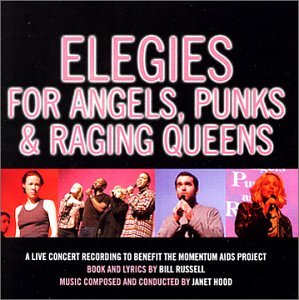
Elegies for Angels, Punks, and Raging QueensI’m sure that many of the people involved in last night’s benefit performance of Elegies for Angels, Punks, and Raging Queens looked on the event as a once-in-a-lifetime experience. Not me. I hope this is but the first of many future projects that I’ll be able to take part in that bring together so many talents for the purpose of making a statement about the values of our community, and to benefit those in need of some extra help. Clearly, this was not your run-of-the-mill benefit performance. I’m willing to bet that almost everyone involved in the show has been touched in some way by the AIDS epidemic, but the real point of coalescence for me was that our performance not only raised money for AIDS-related care, but the content of the performance itself paid tribute to those who have gone, those who survive, and those who support. Powerful stuff. During the dress rehearsal, when I heard most of the monologues for the first time, I was brought to tears countless times… the elderly lady who contracted HIV through a transfusion and learns to overcome her own prejudice to die with grace alongside a drag queen… the couple whose families are incredibly supportive until the first partner dies… the street punk drug user who finds an unlikely friend in a gay social worker… and on and on. The songs have never sounded better, surely, but I hope the final album product will be able to convey at least a taste of the scope of this work – gay, straight, bisexual, nonsexual, black, white, Latino, old, young, and unborn AIDS deaths.  Continue reading

Fynsworth Alley: Tom Jones (Part One)

Originally published on Fynsworth Alley.

Tom JonesTom Jones is the book-and-lyrics half of the team that created The Fantasticks, 110 in the Shade, I Do! I Do!, Celebration, Philemon, Colette Collage, and more.

DL: Let’s start right at the beginning. Before you met Harvey Schmidt, what were you doing? How did you guys get to know each other?

TJ: We were both students at the University of Texas. I was studying drama, studying to be a director, not a writer. Harvey was studying to be a commercial artist, as he eventually became very successfully, as I’m sure you must know. I tried to make as much money as I could by picking up directing jobs, directing the melodrama at the local civic theatre, so forth and so on. But there was the annual college musical, put on by the fraternity connected with the journalism department to raise money. They paid the director, and they paid a very modest fee for the book and score. I got the job directing it, and the scripts that I got and the songs that were sent to me were so terrible that I contacted Harvey, whom I knew through a group called the Curtain Club, and I said, “Look, would you like to write an original musical with me? We’ll write it in three weeks or so, and it will be put on a month after that.” He said yes, and we did.

DL: What was it about Harvey that he was the one who sprang to mind?

TJ: Well, he played the piano. And he also composed. The organization we belonged to called the Curtain Club had just done a revue called Hipsy-Boo! (That’s Hipsy-hyphen-boo-exlamation point.) in which some girls in little pants and mesh stockings and bras came out on a runway… actually, it was a revue of American popular theatre music from 1900 to 1950, it took place in 1950. Harvey arranged music from all of these different periods of time, and played it. And he also wrote an original piece of music called “Hipsy-Boo!” – a wonderful, terrific, sensational, sleazy piece of music. I loved it so much. I was connected to the show writing and directing the comedy material involved. That’s how I met him and knew his talents as a composer, really just through that one song. Continue reading