Fynsworth Alley: David Shire

Originally published on Fynsworth Alley.
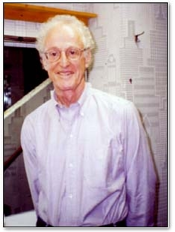
David ShireDavid Shire is composer of Starting Here, Starting Now, Closer Than Ever, Baby, and Big, as well as an Emmy and Oscar-winning film composer whose work includes Saturday Night Fever, Return To Oz and the recent television film These Old Broads. He is currently working with longtime collaborator Richard Maltby, Jr. on a new Broadway-bound show called Take Flight.

DL: Let’s start out talking about your days at Yale, and how you began working with Richard Maltby.

DS: When I went there, I knew I wanted to write shows, and so did he. He came from a prep school in one place, and I came from a prep school in another place. We were looking for collaborators to write what in those days were called Varsity Shows, to be produced by the Yale Dramat. A mutual friend introduced us in the freshman dining hall one day. He thought I was a hick from Buffalo, and I thought he was a theatre snob. We were both kind of right. We started writing together, and 40-plus years later, we still are. We wrote two shows at Yale which were produced by the Yale Dramat in rather elaborate productions. One of them was later done at Williamstown. And that’s how we met.

DL: Those shows at Yale helped launch your career and brought you some professional notice…

DS: A little bit. They didn’t really affect anything. We were trying to get further productions of the shows. Theatre people came up, and though they thought we were talented and promising, neither one of those shows went any further. Curiously enough, the people in the shows who we worked with at Yale were more valuable in terms of future work, even in films. The stage manager of one of the shows was John Badham, who I later scored a lot of TV movies for, and finally Saturday Night Fever, which was my biggest financial windfall. There were people like Dick Cavett in the show, and Austin Pendelton and Peter Hunt, who I’ve either worked with or stayed pretty close with through the years.

We pretty much had to get to New York. After we got the National Guard out of the way – the six month reserve program – we moved to New York and started writing an Off-Broadway show there which was produced about a year after we got there. That attracted professional notice. It was like a calling card, even though the show didn’t run that long. Continue reading

Fynsworth Alley: Karen Morrow

Originally published on Fynsworth Alley.

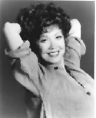
Karen MorrowKaren Morrow is perhaps best known as “one of the most flop-prone performers of recent musical-theatre history,” (according to Ken Mandelbaum), having appeared in I Had A Ball, The Grass Harp, I’m Solomon, A Joyful Noise, and The Selling of the President on Broadway. Since then, she has gone on to success as a television star and cabaret performer. Additionally, Karen is a great teacher of performance, currently on the faculty of UCLA’s Musical Theatre program. Karen Morrow appears on the Fynsworth Alley CDs A Hollywood Christmas, Lost in Boston IV, and The Grass Harp.

DL: How did you get your start in show business?

KM: I went to Milwaukee when I graduated from college to teach school. I had five roommates because I was poor – they certainly didn’t pay much to teach school. I would brag all the time about how I could sing and how I had played all the leads in school. There was an audition at the Equity theatre in town for Brigadoon, so my roommates said, “Okay, smarty, if you’re so good, go over there and audition.” I went “Oh my God…” and went over there an auditioned and got the job! I was in the chorus at the Fred Miller theatre in Milwaukee. Then right from there, I did just about everything in town there was to do. There was a revue in a restaurant called “Highlights of Musical Comedy,” and I was in the original group for that. Then I starred in the big show in Milwaukee with the symphony, and then I went to New York and that was it.

DL: So you gave up teaching?

KM: Oh gosh yes! It was grade school – I didn’t have a clue what I was doing! It was just something to make a living. As I do in my act, there’s a whole song Billy Barnes wrote for me… I have this voice and I didn’t know what to do with it. It never occurred to me that I might be able to earn a living using my voice. And suddenly, there I was earning a living. Continue reading

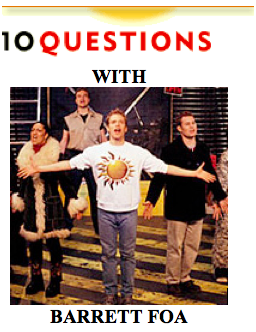
Fynsworth Alley: 10 Questions with Barrett Foa

Originally published on Fynsworth Alley. 

10 Questions with Barrett FoaHow did you get your start in the business? What brought you to New York?

I was born and raised in New York. I went to the University of Michigan musical theatre program. When I graduated, along with everyone else I came here to make it big.

What did you think of Godspell before you were cast in the show? How did this production change your idea of the show?

Actually, I’ve never seen it. I owned the recording and knew some of the songs, but I definitely had pictures of flower children and face painting, hippy-dippy stuff. It was refreshing to revisit it and make it our version of hippy-dippy.

Godspell is the kind of show where the cast really shapes a lot of the action. What was the rehearsal process like for you?

We stripped the script of all of the old jokes. We had our first read-through, and I’ll never forget it, because it was the most boring thing ever. It was Jesus talking for ten pages, with someone saying a line here or there or telling a small parable. We were all falling asleep, it was just atrocious. Then we broke the script down into the separate parables, we sat in a circle and said, “Okay, this parable about the Pharisee and the Tax-Gatherer, what could this be?” We thought, “This could be an infomercial, this could be a football game.” “Football game! All right, someone go out into the hall and make this a football game.” So Chad Kimball jumps up and says, “Hello everybody, and welcome to Synagogue Stadium…” And then Tim would jump up and it would just go on from there. It took about three days just to do the first one, but then we found a rhythm and it just clicked.   Continue reading

Fynsworth Alley: Donna McKechnie

Originally published on Fynsworth Alley.

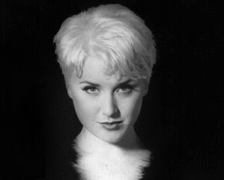
donna mckechnieDonna McKechnie is best known for her Tony Award winning performance as Cassie in A Chorus Line, but her career has spanned four decades, from her start in the chorus of How To Succeed in Business Without Really Trying all the way through the upcoming Broadway revival of Mack and Mabel. She made her first big splash as a featured dancer on the television show Hullabaloo, where she met Michael Bennett, with whom she would create memorable dances in Promises, Promises, Company, A Chorus Line and more. In recent years, Donna has starred in State Fair on Broadway, Follies at the Papermill Playhouse, and Mack and Mabel as part of the Reprise concert series in Los Angeles. She is currently performing in her one-woman show, and she appears on the forthcoming Fynsworth Alley CD, You Never Know.

DL:When you were a little girl, what made you want to be a dancer?

DM: It was never a question for me. I guess I’m lucky that I didn’t need to grow up and go to college to wrestle with what I wanted to do with my life. Maggie’s story in A Chorus Line, in the song “At The Ballet” is my story. I used to dance around the living room with my imaginary Indian Chief. And it was never separated from the music; the music and the movement were both equally important to me. So my mother took me to ballet classes, and I eventually worked my way up from the little local classes to more serious classes. By the time I was in junior high, I was giving lessons to little girls in my basement. Sheila’s story in A Chorus Line is mine, too, watching The Red Shoes and being inspired by the girl with the red hair. From the time I saw that movie, I wanted to dance ballet.   Continue reading

Fynsworth Alley: Tami Tappan

Originally published on Fynsworth Alley.

Tami Tappan

Tami Tappan is one of our most frequently asked about singers. Who is she? Where did she come from? What has she done? Rather than ruin the surprises in this introduction, read on and find out! If you are already lost, you can hear Tami on The Stephen Sondheim Album, The Paul Simon Album, and The Fynsworth Alley Christmas Collection.

DL: How did you get started with your career in musical theatre?

TT: I went to Carnegie Mellon University, and I was in the music theatre department. It was the music theatre in the drama department, so it meant that no matter how well you sang or danced, if you didn’t pass your acting classes, “bye bye.” I actually liked it for that aspect, because in Washington, D.C., where I grew up, much like Emily Skinner, I was forced to go into professional theatre, because there was no community theatre in my little hometown of Laurel, MD. I became a character actress there, really. I got into one show in DC, so then whenever a director needed a fifteen year old, they would think “let’s call her and her and her,” so I was able to go literally from musicals in dinner theatre to dramas downtown. I had received a Helen Hayes award for a John Guare show I did downtown. That was my impetus to get into acting professionally. I thought, “if they think I’m good enough, I guess I should give this a shot.”   Continue reading

Fynsworth Alley: 10 Questions with Bill Russell

Originally published on Fynsworth Alley.

10 Questions with Bill RussellMost people know you from Side Show, but before that, you had an Off-Broadway hit with PAGEANT…..how did that show develop and where did the idea come from?

Pageant has a long, involved history… In the mid-eighties a bunch of guys I knew were on tour with 42nd Street and had been for a while. They were in Boston and decided to do a drag pageant for the rest of the company. They were staying at the Bradford Hotel, so they called it the “Miss Bradford Pageant” and threw it together. Since they were all gypsies, they did some production numbers, one being “I Enjoy Being a Girl.” Bobby Longbottom was one of that group, and he called me to say he thought the idea had the makings of an off-Broadway show. I was dubious — I’d never been a big drag aficionado and thought beauty pageants had been satirized to death, but then I received a video of the “Miss Bradford Pageant” and couldn’t stop laughing. Also, because the cast was Broadway gypsies, the talent on display was considerably better than in real pageants. At the time I was collaborating on a revue called The Texas Chainsaw Musical with Frank Kelly and Albert Evans and got them interested in Pageant. We did a showcase production in 1986, which was very successful and extended, but it took until 1991 for a producer to take it to off-Broadway. Last year I directed the European premiere at the King’s Head Theatre in London (a fringe theatre), and that production transferred to the West End. I’m happy to report we just received two Olivier Award Nominations. I’m about to direct the show in Chicago. Luckily, pageants are so retro anyway that the show hasn’t dated…  Continue reading

Fynsworth Alley: Kenney Posey

Originally published on Fynsworth Alley.

Kenneth PoseyKenneth Posey, the current star of Jekyll and Hyde in Germany, recently released an album called If I Sing, which we’re offering for sale on the Fynsworth Alley web site under special arrangement. Before joining Jekyll, Kenneth performed in Phantom of the Opera, Beauty and the Beast, several other musicals and a plethora of operas. To find out more about him, visit http://www.kennethposey.de, his official web site. Or just read on…

DL: So, I’m sure the first question you always get asked is how a guy from Houston ended up as a staple of German musical theatre. What’s your story?

KP: Shortly after graduating from high school, I left Houston to train as an opera singer. After chasing every teacher, every school, every chance – I ended up in Boston. Ironically, a result of my education was the realization that making a living as an opera singer in the US was almost impossible: too few opera houses and too many singers. It was 1990. The Berlin Wall had just come down, Germany was still in two parts but talking reunification, and I decided to go. I immediately got a job in a small opera house in eastern Germany where I guess you could say I completed my education – over 30 roles in three years! I then worked my way into the mainstream of the German opera world and spent a couple of years singing non-stop but living mainly in hotels. When a call came, inviting me to Switzerland for a new production of Phantom of the Opera – 13 months of living in one beautiful city – I accepted it without a thought. One Phantom led to another (Hamburg) then came another new production (Disney’s Beauty and the Beast) followed immediately by Jekyll & Hyde. Ten years after leaving the US, I’m still here and having a great time!   Continue reading

Fynsworth Alley: Liz Callaway: Feelin’ Groovy

Originally published on Fynsworth Alley.

Liz CallawayLiz Callaway is about to release her first new album in over five years, a collection of songs from the 1960’s called The Beat Goes On. This album will join Liz’s two other solo efforts in the Fynsworth Alley catalog, Anywhere I Wander, a Frank Loesser tribute, and The Story Goes On, an eclectic collection of theatre songs, ranging from Sondheim to Berlin and more. Liz came to the recording world from Broadway, where she appeared in the original casts of Merrily We Roll Along, Baby, and Miss Saigon, before joining the cast of Cats for five years as Grizabella. You may also recognize her voice from her many animated roles, including Anastasia and The Swan Princess. Lately, Liz has been touring the globe, both with her sister Ann Hampton Callaway (in their show “Sibling Revelry”) and on her own.

Her new album, The Beat Goes On, will be available exclusively on the Fynsworth Alley website beginning Februrary 5th, with pre-orders starting on January 22nd.

DL: You were the first vocalist to record an album with Bruce. How did that happen?

LC: He actually just wrote me a letter and introduced himself. He was with Bay Cities at the time, and he just said he wanted to know if I wanted to record an album of Frank Loesser music for him. And it’s funny because I at the very end of my time with Miss Saigon, I had thought, “Boy, I would sure love to do an album,” but I had no idea how to go about getting one made. And I had even said to my husband that this should be a goal of mine, when this letter came. So I was spared the grunt work! I met Bruce, and we hit it off.

And then it was a matter of Bruce sending me tapes of songs he liked, and finding a musical director, and that was it. Continue reading

Fynsworth Alley: 10 Questions with Stephen Cole

Originally published on Fynsworth Alley.

10 Questions with Stephen Cole

How did you get involved in writing for theatre?

I always wanted to be a performer and I began doing summer stock when I was 14. During that summer I became friends with another apprentice, who had written this huge script, which was the book of a musical. But it had no songs yet. So I said, “why don’t I write the songs?” And I wrote my first lyric (tune too!). It was called “The Pleasure’s Mine.” I don’t know what ever happened to that show, but the author was Charles Busch. So I guess I have to thank Chuck for making me a librettist/lyricist. I enventually used that song in my first musical, which I wrote when I was 15 and had produced at Brooklyn College at 16. After that I retired to concentrate on my acting career, which ended when I was no longer a child star. It was at that time that I started to concentrate my efforts on writing for the theatre.

The craft of writing books for musicals is often under-appreciated. Do you have any bookwriting idols or role models?

I have dozens of idols and role models, beginning with Oscar Hammerstein and Alan Jay Lerner. I think the book writers who did their own lyrics influence me the most, since that is what I do. The singular voice. Gypsy is perhaps my favorite musical, so Laurents has to be in the group. I can quote every line from that show. A very big influence would also be James Lapine. All you have to do is mention Sunday in the Park with George and I cry. He hit me right where I live. I don’t think he is given enough credit as a librettist, but two of Sondheim’s best shows have book and direction by him. While on that subject, there is the grace and elegance of Hugh Wheeler, who really makes A Little Night Music sing between and sometimes during the songs. There are many more. I once wrote a song called “The History Of The Librettist,” with Jeff Saver. It basically said that “if the show if good no one will know your name and if it’s bad, you get the blame!”   Continue reading

Fynsworth Alley: 10 Questions with Doug Cohen

Originally published on Fynsworth Alley.

Doug Cohen

How did you get involved in writing for theatre?

The first theater song I ever wrote was in the fifth grade. We were doing Humperdink’s Hansel and Gretel and I was cast as The Sandman. Essentially, he gets one solo and you never see him again. I had a really nice voice, so I was crushed that I didn’t get Hansel. But instead of bemoaning my fate, I invented the role of a Narrator/Troubador and wrote a song for him to sing which “opened” the show. And my teacher actually let me perform it!

I also used to write lyrics for mock court cases in the sixth grade. I remember having to present a case opposing abortion and writing (to the tune of “Over The Rainbow”), “Somewhere deep in her stomach small and sweet…there’s an innocent baby someday I’d like to meet.” It may not have been up there with the lyrics of Larry Hart, but I never lost a case!

I turned to more serious writing at Amherst College when I decided to write book, music, and lyrics to a contemporary musical fantasy loosely based on Dr. Jekyll and Mr. Hyde. I also produced, directed, and performed in it. (It was either that or writing a senior thesis devoid of internal rhymes!) I loved the experience and decided to move to New York after graduating where I joined the BMI and ASCAP Musical Theatre Workshops. Continue reading