Fynsworth Alley: Dorothy Loudon: She’s Still Here

Originally published on Fynsworth Alley.
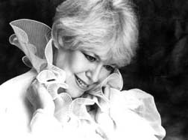
dorothy loudonWe often hear stars referred to in hyperbolic terms, but Dorothy Loudon is the real thing: a Broadway legend. Best known for her Tony-award winning performance as Miss Hannigan in the original cast of Annie, Dorothy’s career has spanned radio, television, cabaret, theatre, and film. Recently, Dorothy shared with me some of her showbiz memories and discussed her track on THE STEPHEN SONDHEIM ALBUM, “I’m Still Here.”

David: How did you get your start in show business?

Dorothy: After my sophomore year at Syracuse University, I left – on the advice of my drama coach – and came directly to New York City. I lived in a girls’ club and auditioned for anyone who would listen. My first job was in a tiny club called “Jimmy Ryan’s,” where I sang and accompanied myself on the piano. One night, Jackie Gleason came in with his musical conductor, Ray Bloch. I guess they were impressed, because Mr. Bloch put me on CBS radio, where I was heard nationally every Friday night. From that time on I never stopped working. That was before television. That was fifty years ago. I was a very lucky girl.

David: You were a fixture of the 1950s cabaret scene in NY. Has the cabaret scene changed much? How? What was it like back then, doing shows in the boites?

Dorothy: The cabaret scene has changed tremendously since the fifties and sixties when I was there. People “dressed up” for the occasion. Tuxedos, gowns, “the works”.

On a typical night at “The Blue Angel,” I would appear on a bill with Johnny Mathis (opening act), Jonathan Winters, Phyllis Diller, Mike (Nichols) and Elaine (May) – and Bobby Short was playing in the lounge!

Television came along and literally wiped out the supper clubs. Now, people could sit at home, turn on their sets and see all those people in their own living rooms. What’s more, they could watch in their pajamas, and there was no cover charge.

David: How did your role on the Garry Moore show come about?

Dorothy: One day I got a call from the Garry Moore Show – Gwen Verdon was to have been their guest star, but she had the flu and couldn’t make it. It was two days before the show and they were desperate. I had auditioned twice for the show — and was turned down. I jumped at the chance. In two days I learned the sketches, songs, choreography… and went on for Gwen. That night, after the show, Garry offered me a three year contract.

David: Was that your “big break”?

Dorothy: It turned out to be the biggest break of my career.  Continue reading
Adams House Pool Theater: Revisionist History

Revisionist History premiered April 30, 1998, at the Adams House Pool Theatre, Harvard University, Cambridge, MA, as part of the ARTS First Theatre Festival. This production was directed by the author and ran five performances. The original cast consisted of Pippa Brashear as Gaby, Janel Moore as Rachel, Michelle Capasso as Sue, and Maya Bourdeau as the professor. 

THE TIME:  The present.

Gaby's bedroom

Gaby’s bedroom

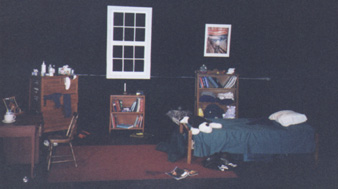
THE PLACE: A dormitory room; a large single.  The back wall is covered with three gigantic windows overlooking the streets of an average college town.  A bed with its head resting against the SR wall cuts the room into upstage and downstage halves.  Upstage of the bed, on the floor, is a half-completed art project, a collage of sorts.  On the SL wall, opposite the bed, is a bookcase and bureau.  The bookcase is being used more as a de facto display case, with picture books open to various pages, knick knacks, and jewelry scattered over the shelves.  These item s are not neatly ordered.  The walls are covered with charcoal drawings of disturbing faces, athletic female bodies (dancers, rowers, runners, etc.), and the occasional landscape.  Interspersed with these are a few photographs of GABY’s family members.  A CD player rests downstage right, on the floor, near enough to the bed so that it can be operated without rising.  A phone sits in a similar position on the floor next to the other side of the bed.

The only entrance to the room is from the audience.  However, actors should be able to enter undetected during blackouts.

THE WOMEN:

GABY:  A young woman in her second try at a freshman year of college.  She is an athlete, running track and rowing crew. She is tall and slim, and she’s always dressed in layers of mismatched, worn out athletic clothes.  Around her neck she always wears a funky modern crucifix-necklace.  While she could easily pass as white, occasionally she chooses to drop subtle hints that her father is black.  She has specific sets of actions and emotions that she uses, depending on with whom she is interacting.  How she acts when she is alone is the mystery left to the actor.

RACHEL:  One of GABY’s best friends at college.  She is also a first year student.  RACHEL is short, sarcastic, and occasionally sexy.  She comes from a relatively rural area, but is anxious to become a city native.  When she gets stressed or upset, she occasionally purges in the dorm bathroom.

SUE:  GABY’s best friend on the crew team, also a freshman.  SUE is a tall, muscular, self-assured young woman.  Although SUE has a very masculine build, her gorgeous hair and winning smile remind her friends that she is a cuddly amazon.  She is romantically involved in a very serious, long distance relationship with Deanna, a high school senior from her hometown.

THE PROFESSOR:  THE PROFESSOR exists in her own time and space, in a tidy office, or perhaps a lecture hall, somewhere in the theatre – on the stage, in one of the boxes, the exact location is not important as long as it does not impose upon GABY’s space.  She is a professor of History.  She is also an occasional observer to the action of the other characters.  Her watching is at times clinical, at times voyeuristic, and at times paranoid.

THE PLAY:  Continue reading