JewishBoston.com: In a Love Triangle with Art & Religion: My Name is Asher Lev at the Lyric Stage Company

Originally published on JewishBoston.com.

When someone inherits more than one tradition, how can he make them mesh? For many contemporary Jews, this question may arise when parents come from different faiths or different Jewish streams. For the title character of My Name is Asher Lev, the challenge arises when a Hasidic boy turns out to be an artistic prodigy. Religious Jews aren’t meant for the arts, we’re told. To paint requires breaking all manner of mitzvot (religious laws), from the second commandment (you know, the one about graven images) to the rules of modesty and honoring one’s parents. Those last two are particularly troublesome for Asher, whose artistic impulse leads him to paint nudes and eventually crucifixion scenes featuring his parents. To use director Scott Edmiston’s art-world metaphor, Asher must figure out in which frame he will live his life.  Continue reading

JewishBoston.com: New Rep’s Cherry Docs: Exploring Our Capacity to Love and Hate

Originally published on JewishBoston.com.

Does every person have the capacity to hate?  Does every person have the capacity to love?  These questions are at the heart of Cherry Docs, a provocative play by David Gow on stage at the New Repertory Theatre in Watertown.

The play tells the story of Danny Dunkleman (Benjamin Evett), a secular Jew from Toronto whose job as a public defender lands him on the case of Mike Downey (Tim Eliot), a skinhead who has killed a Pakistani man. When we meet both men, they are full of (self-)righteous anger.  Mike is angry at the world for the crummy hand he’s been dealt in life as a poor, uneducated white man who can’t hold down a job. Danny is angry that such men as Mike exist, although his commitment to liberal ideals of justice for all keep him on the case.

created at: 2010-10-25Despite having every reason to hate each other, Danny sees potential in Mike’s intelligence and challenges him to rise to his own defense.  Danny in turn respects that Mike treats him as a human being and not simply an embodiment of skinhead ideology. While the men certainly don’t become friends, Evett and Eliot portray a nuanced courtship of sorts that makes their mutual seduction totally believable.

Confined to one small, claustrophobic set (designed by Jenna McFarland Lord), director David R. Gammons’ staging emphasizes the ways in which hatred (and the prison system) can rob individuals of their humanity.  Eliot stalks his cell like a caged lion, and in a climactic moment, Evett takes on the role of a lion tamer at the expense of a folding chair.

For all its simmer — and there’s plenty — the play lost me at the climactic moment.  I won’t spoil it for you, but when Mike, having come to the brink of renouncing his skinhead philosophies, collapses back into a rant about the Zionist Occupation Government, Danny reacts in a way that, to this Jew, felt totally improbable.

Despite my inability to accept the pivotal moment in the show, I found a lot to like in the production.  Most importantly, a week after seeing it, I’m still thinking about the questions it raises. In a world where issues of discrimination and racially-based recriminations still make headlines every week, it’s important to step back and ask ourselves where we fit in the equation of love and hate. Cherry Docs reminds us that we may be surprised to find the answer.

Cherry Docs is playing at the Arsenal Center for the Arts, Charles  Mosesian Theater, 321 Arsenal Street, Watertown, MA 02472, through November 7. Tickets are Full Price $28-$58. Seniors $7 off full price. Student rush $14. Call: 617-923-8487 or buy online at www.newrep.org

There are free post-performance discussions following the evening performance on October 30th and matinée on October 31st.

Photo by Andrew Brilliant/ Brilliant Pictures.

It’s Not Where You Start: I’m Hip

Originally published on It’s Not Where You Start.

Tonight I attended the Boston premiere of Howl, the Allen Ginsberg bio-pic starring James Franco as the preeminent beat poet. I have been looking forward to this movie for about a year, and not only for the promise of seeing James Franco make out with Aaron Tveit.

It may not surprise you to know that I’ve always had a special place in my heart for Ginsberg. As a gay Jewish kid growing up in a town with few gay or Jewish (and no gay, Jewish) peers, I found both Ginsberg’s biography and his poetry resonated with me quite a bit when I first encountered it at age 14 or so. Looking back, I wonder if that’s entirely accurate, or if I knew that beat poetry was supposed to appeal to alienated youth, so I convinced myself I liked it. I do remember getting a thrill from “Please Master” that had as much to do with seeing a portrayal of my sexuality as it did with seeing any portrayal of sexuality.
Continue reading

JewishBoston.com: King Arthur, Nazi Hunter? CAMELOT at the Trinity Repertory Company

Originally published on JewishBoston.com.

King Arthur, Lancelot, Merlin and Guenevere have taken the stage at Providence’s Trinity Repertory Company, but don’t look for castles, armor, or lances. In Curt Columbus’s production, Camelot has been reset in a tube station during the Blitz, when British civilians sought safety underground as German bombs pelleted the city. I applaud Columbus’s wililngness to treat a classic musical with the same respect and spirit of experimentation he would treat a Shakespearean play. And it’s not a terrible idea for a framing device, both because during the Blitz British theater companies did, in fact, perform in the tube to help keep spirits up, and because Camelot’s source, The Once and Future King, originated in the World War II era. But it’s not a burst of genius that will shed new light on this classic story for you, either.  Continue reading

Jewschool.com: B’chol dor vador

Originally published on Jewschool.com.

B’chol dor vador chayav adam lir’ot et atzmo k’ilu hu hatza mimitzrayim. In every generation, each person must consider himself as if he had come forth from Egypt.

I spent the last night of Passover not in shul, but taking part in a Jewish communal ritual nonetheless. I was in the audience at the Kravis Center for the Performing Arts, seeing a touring production of Fiddler on the Roof.

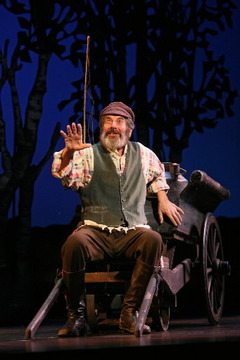
Topol as Tevye This production is being billed as Topol’s “Farewell Tour” with the show, in the role he’s been playing for over 40 years on stage and screen. And frankly, that nearly kept me away from the show – Tevye should be in his early 40s, not his early 70s. But I had never seen Fiddler on stage, so I couldn’t resist.

During the performance, I kept thinking about how the show felt like a seder to me. We were retelling – in some sense, reliving – a story that most of us already knew. The audience was a palpable part of the storytelling, from the massive entrance applause that greeted Topol when he first appeared from behind Tevye’s house, to the clapping that made us a part of “Tradition,” to the roars of approval the first time a trademark niggun or chasidische dance move appeared.

There was a generational shift going on, with Topol passing on his show to a new generation, and with parents and grandparents passing on the show to their children and grandchildren. My mother told me about the first time she saw Fiddler, on a trip to Broadway when she was in college. I told her about the time I went to “Sing-a-Long Fiddler on the Roof” at the Somerville Theater.

Topol in Fiddler on the RoofBut just as the seder seems to take on new meaning for every generation, I found myself seeing new things in Fiddler on the Roof that I had never noticed before. For one, I’m pretty sure this is the first time I found myself most identifying with Perchik, the activist. And perhaps related to that, I was taken with how much of the show is about enlarging the traditional definition of marriage. (I also wondered if everyone else in my age bracket has permanently associated the song “Anatevka” with the series finale of Newhart. Despite reminding me of the departure of Larry, Darryl, and Darryl, the song still managed to break my heart.)

Most strikingly, I can’t believe how moved I was by a show that, despite never having seen it on stage before, I still know inside and out. I laughed far more than I expected to, and I cried at every moment I’m supposed to. I even found myself moved at times I would have never predicted, like the moment Perchik crosses the mechitza to introduce mixed dancing to Anatevka. The themes of triumph and loss, progress and prejudice all resonated as strongly with me tonight as I imagine they did for the original Broadway audiences in the 1960s and for Sholom Aleichem’s readers at the turn of the century.

And I wonder. What will the next generation to receive this “Tradition” make of it? Will the struggles with tradition faced in the mythologized shtetl feel relevant to kids who’ve grown up in a Jewish community more open, diverse, and fluid than the one I’ve grown up with? On the one hand, I hope that these struggles seem quaint and distant to my children and theirs. But on the other hand, the march of progress ever continues, and just as I see new things in Fiddler today that I never saw before, I’m sure the next generation will find new meaning as well. We are always leaving Egypt. We are always leaving Anatevka.

PS – To restate the obvious, this production is better than I expected it to be, or really than any aged-star-recreates-the-role-that-made-him-famous-40-years-ago production has any right to be. The tour continues through the end of August. Go see it! You won’t regret it.

Jewschool.com: 13, The Musical

Coauthored with The Wandering Jew. Originally published on Jewschool.com

1 (dlevy). Thursday night, TheWanderingJew and I saw 13, a Broadway musical with songs by Jason Robert Brown, book by Dan Elish and Jason Robert Brown. The show tells the story of Evan Goldman, a 12-year-old kid from the Upper West Side of New York whose parents get divorced on the cusp of his bar mitzvah. His mom moves him to Indiana where he must make new friends in time to have anyone at his Bar Mitzvah party, while trying to figure out what exactly it means to become a man. (Thanks to the good folks at the Theater Development Fund, which provides access to discount tickets to students, educators, and folks who work at non-profits…)

2 (dlevy). It is very tempting for me to write an entire dissertation on this show. I am itching to trace the reflections of Sondheim (tell me you don’t hear hints of “Merrily We Roll Along” in the title song) and figure 13′s place in the growing body of Jason Robert Brown’s work and rhapsodize on how the present Broadway season and world economy frame this show both for its audience and its creators… but that’s a bit outside the scope of the Jewschool readership’s primary areas of interest. I’m going to trust that TheWanderingJew will edit down my ramblings a bit.

3 (TheWanderingJew). My expertise is nowhere near as in depth as dlevy’s when it comes to all things Broadway. I might have thought some of the tunes sounded familiar – they clearly borrowed from other musicals and standard music genres (doo-wop, blues, country, etc.), but what I tried to focus on were the kids’ abilities. The cast was clearly talented, though I felt the music didn’t fully allow them to shine. Malcolm and Eddie had amazing energy, and really played off each other (and their friend, Brett) well, stealing scenes as well-choreographed backup singers. Patrice was able to portray her awkwardness and strength in her solos… Maybe I should just have said that the play was well cast?  Continue reading

Talkin’ Broadway: The Bubbly Black Girl Sheds Her Chameleon Skin

Originally published on Talkin’ Broadway.

Stephanie Umoh and Jaime Cepero III

Don’t be scared by the verbose title:Bubbly Black Girl is a surprisingly traditional musical coming of age story.  The spirited cast takes us from Los Angeles in the early ’60s to New York in the mid-’90s in a series of musical scenes loosely based on the life of playwright/composer/lyricist Kirsten Childs.  Childs first hit the stage as a Broadway dancer, eventually starring in Chicago opposite Chita Rivera.  Becoming frustrated with the roles available to African-American actors, she turned her talents to writing.

Bubbly Black Girl follows the story of Viveca, a black woman not entirely unlike Childs, who finds life much easier to navigate with a smile and a “bubbly” exterior. Eventually, her experiences growing up in the civil rights era and struggling to succeed as a Broadway dancer call into question the wisdom of living behind this façade. As the title promises, by the eleven o’clock number we see her shed her “chameleon skin” and commit herself to living with integrity.

Jacqui Parker, the star of last year’s Caroline, or Change, has stepped into the director’s spot for this outing.  Along with choreographer David Connolly, she’s put together a show that dances from scene to scene, era to era with grace befitting a show written by a dancer. Connolly makes good use of period dance steps to convey the passage of time, and he gives us a couple of delightful set pieces showing off the entire cast.

Stephanie Umoh, as Viveca, is on stage for almost the entire intermissionless show. While she sings and acts well, she’s not particularly convincing as a dancer, and she never quite achieves the luminosity of star quality called for by the role. She’s entertaining, but not nearly magnetic enough to carry this show on her back.

Her job is made a bit harder by the terrific supporting cast, many of whom prove to be far more interesting than the leading lady in the scenes they share with her.  Anich D’Jae, as Viveca’s friend Emily, exhibits expert comic timing as she teaches her friend the new rules for courting in the age of Black Power.  Jaime Cepero II similarly steals the spotlight as Viveca’s love interest, Gregory.  From his very funny turn as the only little boy in Viveca’s childhood dance class to his more adult declaration of love in the number “Beautiful Bright Blue Sky,” Cepero is a magnetic presence on stage.  Towards the end of the show, Trecia Reavis brings down the house with “Granny’s Advice,” a show-stopping blues number.

The cast is ably supported by a tight five-piece band under the direction of José Delgado.  John R. Malinowski’s evocative lighting and Eric Levenson’s minimal set pieces skillfully convey the variety of locations called for by the script.  Seth Bodie’s costumes are at times delightful, especially when he takes the opportunity for exaggeration, such as in the hippie and Black Power scenes.  However, his clothes for Umoh are distractingly ill-fitting, and some of the wigs employed make the women of the cast look like drag-queens parodies of the ’70s.

The biggest problem inherent in the show is one that Parker never quite solves.  The play is not nearly as edgy or adventuresome as one might expect from the title.  And that title also tells us exactly how the play will end, so the director’s challenge is making the journey there as captivating as possible.  And, despite some great supporting performances and a few excellent numbers, Bubbly Black Girl never quite sheds its own theatrical skin to become something greater.

SpeakEasy Stage Company presents The Bubbly Black Girl Sheds her Chameleon Skin, now through December 9 at the BCA Roberts Studio Theatre, 527 Tremont Street in Boston’s South End. Tickets and times atBostonTheatreScene.com, 617-933-8600, or at the Calderwood Pavilion Box Office, 527 Tremont Street.
Photo: Craig Bailey/Perspective Photo


Talkin’ Broadway: The 25th Annual Putnam County Spelling Bee, Little Shop of Horrors, The Women

Originally published on Talkin’ Broadway.
The 25th Annual Putnam County Spelling Bee

The opening of Boston’s very own company of The 25th Annual Putnam County Spelling Bee gave me occasion to revisit the show, which I first saw over a year ago in its Broadway incarnation. At the time, I posted my feelings on a message board:

“The show is very, very funny. Very funny. Hilarious. The performers are all fantastic, landing every joke, nuance, and song. But … but …

“Well, you can feel the show’s roots in improv. The characters are all fully realized, and the situation is funny, but there’s not a whole lot of depth. Any ‘journey’ a character takes happens in typical William Finn ‘one song epiphany’ style. There’s not much of a through line or an arc to the evening.”

While all of this is still true, it didn’t bother me nearly as much the second time around. Perhaps because I knew what I was in for, I was more able to simply sit back and laugh, which is exactly what I did.

The cast assembled for the Boston production is every bit as good as the New York originals, in a few cases even better. Betsy Wolfe, as host and former spelling champion Rona Lisa Peretti, provides the perfect center to the exuberantly chaotic goings-on at the Bee, a mothering presence who nonetheless has a touch of zaniness herself. She’s joined on the adult side of the proceedings by two excellent character actors: Daniel Pearce, pathetically hilarious as Vice Principal Douglas Panch, and James Monroe Iglehart, striking both fear and comfort into the hearts of spellers and audience members alike as comfort counselor Mitch Mahoney.

Each of the “kids” is a standout in his or her own right. To single out a few: Sara Inbar, as the earnestly dorky, politically-active Logainne Schwartzandgrubenierre, is so perfect in her role that I hoped this time she might win despite the script. Stanley Bahorek’s Leaf Coneybear, the
weirdest of the weird kids assembled, manages to be entertainingly odd in an entirely different manner than Jesse Tyler Ferguson was on Broadway. Jared Gertner captures the nuances of William Barfee, the loser who has convinced himself that winning is better than having friends, without being quite as creepy as Dan Fogler was in the part. The result is a character who’s just as memorable, but considerably more likable and easy to root for.

James Lapine’s direction keeps the show moving along at an exciting pace, and he’s adapted the show well to a more traditional proscenium setup. The design team transfers the show’s gymnasium feel to theatre well, with Beowulf Boritt’s set extending out through the audience and even into the
lobby, thanks to lots of laminated “schoolwork” and motivational posters. The five-piece band serves the score well, with conductor Janet Roma getting in a couple of choice moments of stage business as well.

Spelling Bee may not be a classic for the ages, but it’s a guaranteed evening of laughs. And you’ll definitely want to catch this talented young cast so that when the 50th Annual Bee rolls around, you’ll be able to say you saw them when …
Little Shop Of Horrors

For a different sort of “I saw them when …” opportunity, head down to the Boston Center for the Arts Plaza Theatre, where the Animus Ensemble’ fourth season has begun with a new production of Little Shop of Horrors. The company seems to specialize in musicals about people living on the fringes of society, having presented memorable productions of Once Upon A Mattress (with a male Winifred) and Promises, Promises in previous seasons.

Like those shows, Little Shop deals with outsiders looking for a way into society, in this case the poor schlemiel Seymour Krelborn (Christian Daniel Kiley), orphan flower-shop attendant who sees his big break come in the person of a strange and unusual plant dubbed Audrey II (Neil
Graham). What sets this production apart from every other Little Shop you’ve ever seen is that rather than haul old the rented Audrey II puppet, director John Ambrosino has cast a large, bald, tattooed rock and roll singer to not only voice but also embody the plant on stage. (As the plant
grows, Graham is joined by dancers Erin Pellechia, Christin Fagone, and Maria Larossa.)

The good news is, the approach works, and not only because Graham is a tremendously charismatic personality on stage. Removing the puppet forces audience members who have seen the show before and think they know it inside and out to reconsider what’s happening on stage and take Audrey II a
bit more seriously as a character. The tone shifts from that of a campy tribute to shlock horror to something more akin to a morality play. The result is sometimes goofy, but more often provocative and even a little bit threatening, without sacrificing any of the warmth or humor of the script.

The production is also blessed with a perfect pair of leads. Kiley is a strong singer and endearing presence, winning over the hearts of the audience so we’re on his side even as he begins to kill his acquaintances to feed his plant. Erin Tchoukaleff brings to the role of Audrey a sense of knowing worldliness underneath the bimbo exterior that adds weight to her decisions. It doesn’t hurt that she sings beautifully, either.

The show is played on a unit set, designed by Peter Watson, dotted with evocative ’50s era propaganda and film posters. Choreographer Josie Bray utilizes the “plant dancers” and the ubiquitous urchin girls (Heather Fry, Emilie Battle, and Sehri Wickliffe) in establishing the atmosphere for various scenes, giving each group their own distinct dance vocabulary. And the four-piece band, led by Bob Mollicone, ably balances the rock and roll leanings of the score with the theatrical necessities of the piece, letting loose at just the right moments.

While the show aims high, it doesn’t quite reach the stature of previous Animus productions. Eric Ruben is miscast at Mr. Mushnik, delivering a rather flat portrayal of the flower shop owner. And at times, the performances of supporting players Jim Jordan (hilarious as Dr. Orin Scravello, the S&M dentist) and Perri Lauren in a variety of small roles slip dangerously close to silly collegiate theatre.
The Women
Maureen Keiller and Georgia Lyman in The Women
Next door at the BCA’s Roberts Studio Theatre we have almost the opposite situation: one of our most established
theatre companies (SpeakEasy Stage Company) performing a classic play (The Women) in a relatively straightforward rendition. Director Scott Edmiston wisely gets his ladies on stage and then lets them do what they do best without too many bells and whistles. And this stage is filled with just about the best set of actresses I’ve ever seen assembled. The play centers on Mary Haines (Anne Gottlieb), a sweet woman married to a successful businessman. Mary’s biggest flaw, at least at the start of the play, is her choice of friends, a bunch of gossipy, catty women whose happiness seems dependent on the suffering of others. Of course, what may be misery for the characters is pure delight for the audience, and Clare Boothe Luce’s script is chock full of bon mots deliciously delivered at a breakneck pace.

Leading the charge is the hilarious Maureen Keiller as Sylvia Fowler – imagine Christine Baranski playing Dorothy
Parker in a foul mood, and I mean that in the best possible way. Nancy E. Carroll is the perfect counterweight as Nancy Blake, the acerbic narrator of the show whose deadpan delivery is an ideal balance to the larger than life
Keiller. Gottlieb treads the middle ground, succeeding in the difficult job of creating a sympathetic, interesting, and real heroine amidst the verbal barrage of her friends. Gottlieb manages the most surprising trick in the show – making the audience care as much about the story as they do about the oratory acrobatics.

So much of the cast is so perfect, it’s impossible to find descriptions of their performances, but trust me when I say that from the youngest (Sophie Rich as Little Mary) to the oldest (Mary Klug’s Countess de Lage, or perhaps Alice Duffy’s Mrs. Morehead) the cast sparkles. Georgia Lyman, as
the “other woman” in Mary’s husband’s life, is a pro at the screwball-style machine-gun patter but occasionally missteps in her more dramatic scenes. But most of the missteps are minor in the scheme of this production.

The only serious flaw comes at the end of the first act, when for reasons entirely unclear to me Edmiston makes his directorial hand all too visible by inserting a musical number. The song isn’t entirely inappropriate – Cole Porter’s “Down in the Depths (on the 90th Floor)” certainly captures Mary’s mood at the end of the act, and one could envision it as background music during a filmic fade out on that scene. However, Edmiston brings out his entire cast of nearly two dozen women to belt out a jazzy rendition that dissolved much of the audience at the performance I attended into giggles.

Luckily, that moment is followed by intermission, enabling us all to regain our composure and erase the memory of the moment by the start of act two, which quickly returns to the high quality of the rest of the show.

Photo: Mike Lovett

Talkin’ Broadway: 1776

Originally published on Talkin’ Broadway.
Peter A. Carey and
Eileen Nugent in 1776If the success of 1776 is the treatment of our nation’s heroes as nuanced human beings, then Spiro Veloudos’s season-opening production at the Lyric Stage might be the most successful staging of the show yet. In the Lyric’s intimate house, the audience becomes members of the Second Continental Congress, and the arguments of the colonies become present and relevant. Plus, the small theater allows for unamplified singing, a particular treat when there’s a 20+ voice male chorus involved.

At the center of the show stands John Adams (Peter A. Carey), whose desperate belief in the necessity of independence often overwhelms his knowledge of the workings of diplomacy. Adams is one of the greatest roles in modern theatre, requiring an actor to be at once lovable and “obnoxious and disliked,” carrying much of the show on his shoulders. Carey is utterly engrossing in the part, so believable that at times one almost expects him to collapse from the exhaustion of creating the United States single-handedly.

Of course, this is far from a single-handed job, and he is happily accompanied by a superb acting ensemble. While certainly there are standouts, the entire ensemble is filled with actors who bring to life every delegate, even those who barely speak. Brent Reno, as Lewis Morris of New York, conveys volumes with a pointed look, and John Davin as Delaware’s Caesar Rodney is downright inspirational when he returns to the congress despite impending death from cancer in order to participate in the final vote. Among the more featured delegates are the standouts J. T. Turner as an affable Ben Franklin, and Frank Gayton who brings credibility to Pennsylvania’s John Dickinson, humanizing a character that could easily be played as a one-dimensional villain.

The show isn’t entirely made up of men, and unfortunately, if there’s a weak point in this production, it is the women. While both Eileen Nugent as Abigail Adams and Jennifer Ellis as Martha Jefferson are pleasant singers, they do not bring enough presence to their roles to fully inhabit these women or compensate for the relative brevity of their appearances.

Musically, the show is top notch, with a tight seven-piece orchestra under the capable baton of Jonathan Goldberg sounding much fuller than its numbers might suggest. Janie E. Howland’s set manages to squeeze nearly two dozen delegates onto the tiny stage without ever feeling cramped, and Scott Clive’s lighting is invaluable in focusing the action on such a full stage.

I last saw 1776 nearly a decade ago at the Gershwin Theatre on Broadway. The stage was huge, the country optimistic, and despite the human foibles of the characters, the show still felt like a celebration of our foundational myths. Today, seeing the show in Boston during election season, while our country and many others throughout the world are at war, 1776 feels much more like a wake-up call. This production reminds us that great men are regular guys, and regular guys can be great men. If only we didn’t need the reminder so often.

Talkin’ Broadway: The Most Fabulous Story Ever Told

Originally published on Talkin’ Broadway.

Christine Power and Robin Rapoport

If you’re looking for an opportunity to ponder the big questions of mankind’s relationship to the eternal in the presence of full frontal male nudity, you’re in luck.  The Encore Theater Company has given us a bold and funny production of Paul Rudnick’sThe Most Fabulous Story Ever Told, now playing at the Plaza Black Box Theatre at the Boston Center for the Arts.  The play, originally produced in 1998, originated with Rudnick pondering the anti-gay slogan “God made Adam and Eve, not Adam and Steve.”  What if, he wondered, God had started with Adam and Steve (Albert Chan and Jason Fenton) … and their lesbian friends Jane and Mabel (Christine Power and Robin Rapoport)?.

The Most Fabulous Story follows these four characters through a pageant of Old Testament situations from the ark to Egypt and beyond.  The format provides a frame to not only parody Biblical stories and gay lifestyle quirks, but also to examine faith in an uncertain world.  The second act finds these same characters – now stripped of their Biblical history – living in New York in 1998, dealing with issues of gay marriage, parenting, AIDS, and once again, faith in an uncertain world. Continue reading