Jewschool.com: Anatomy of an Activist

Originally published on Jewschool.com. A slightly revised version was later published in the anthology Living Jewishly: A Snapshot of a Generation.

It took a long time for me to be comfortable calling myself an activist. Although I have been in positions of leadership of some sort or another ever since the fateful night towards the end of the fifth grade when I forgot about Kadima elections and got voted in as the Religious Education Vice President in absentio (when I found out I sobbed), I’ve always seen a difference between “leadership” and “activism.”

When I look back, I can now trace the origin of my career as an activist to one moment, on Shabbat Shuva of 1997. The fall of 1997 began my sophomore year of college. True to form, I had found my way into several leadership positions on campus: I was director of a musical, co-chair of Hillel’s Shabbat committee, and one of four gabbaim (organizers) of the Conservative minyan.

A year earlier, I had kicked off my time in college by coming out to my parents. I had set a deadline with myself that I wanted to be out of the closet by the time I started college, and since I’m bad with deadlines, I told them as they were getting back into the car after unloading everything I owned into my dorm room. I imagined that once I told my parents, I would be “out” and it would cease to be a big deal in my life. Of course, that’s not how it works, and when a half-hour later I found myself in a room full of 40 other new freshmen, I couldn’t figure out how to share this newly open piece of my identity, so I kept quiet about it.
Continue reading

Jewschool.com When Worlds Collide

Originally posted on Jewschool.com.

Last November, I posted about the formation of a Jewish Young Adult Writers’ Forum in the greater Boston area. Last night was the last official meeting of the first cohort, and the guest author was Jewschool’s own Danya Ruttenberg. (We have one more “unofficial” meeting coming up with Anita Diamant, but that’s more of a dinner discussion than formal workshop.)

The way the workshop has worked, each month our guest author sends out a writing assignment for the participants to complete in advance. Our workshop evening begins with dinner, which flows into our guest telling us a bit about her or his career. Next there’s some “in class” writing. Each evening culminates with participants paring up to share the work they did on the assignment, often reconsidering it in light of what’s happened during the first hour of the workshop.

Since you read Jewschool, I don’t have to tell you how wonderful Danya was as our guest leader. The assignment she sent us was this:

Pick a story from the Bible, or a midrash, or a myth or legend from anywhere (Greek mythology, say, or classic literature) whose themes have a particular resonance for you (eg the story of crossing the Red Sea as jumping into something scary and trusting it will work out), and write a story from your life with that myth/legend in mind.

I’ve included my response to this prompt below the cut. Maybe some of you out there in Jewschool-land will add yours, as well.

Incidentally, several of us in the first cohort are meeting in the near future to talk about what might be next for the Writers’ Forum. If you’re a young Jewish adult in the greater Boston area and interested in taking part in writing-related stuff, leave some comments about what you’d like to see and do.

Continue reading

Jewschool.com: B’chol dor vador

Originally published on Jewschool.com.

B’chol dor vador chayav adam lir’ot et atzmo k’ilu hu hatza mimitzrayim. In every generation, each person must consider himself as if he had come forth from Egypt.

I spent the last night of Passover not in shul, but taking part in a Jewish communal ritual nonetheless. I was in the audience at the Kravis Center for the Performing Arts, seeing a touring production of Fiddler on the Roof.

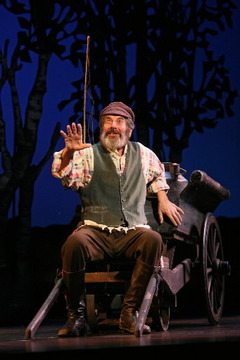
Topol as Tevye This production is being billed as Topol’s “Farewell Tour” with the show, in the role he’s been playing for over 40 years on stage and screen. And frankly, that nearly kept me away from the show – Tevye should be in his early 40s, not his early 70s. But I had never seen Fiddler on stage, so I couldn’t resist.

During the performance, I kept thinking about how the show felt like a seder to me. We were retelling – in some sense, reliving – a story that most of us already knew. The audience was a palpable part of the storytelling, from the massive entrance applause that greeted Topol when he first appeared from behind Tevye’s house, to the clapping that made us a part of “Tradition,” to the roars of approval the first time a trademark niggun or chasidische dance move appeared.

There was a generational shift going on, with Topol passing on his show to a new generation, and with parents and grandparents passing on the show to their children and grandchildren. My mother told me about the first time she saw Fiddler, on a trip to Broadway when she was in college. I told her about the time I went to “Sing-a-Long Fiddler on the Roof” at the Somerville Theater.
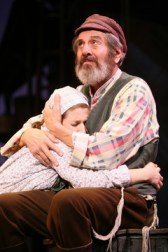
Topol in Fiddler on the RoofBut just as the seder seems to take on new meaning for every generation, I found myself seeing new things in Fiddler on the Roof that I had never noticed before. For one, I’m pretty sure this is the first time I found myself most identifying with Perchik, the activist. And perhaps related to that, I was taken with how much of the show is about enlarging the traditional definition of marriage. (I also wondered if everyone else in my age bracket has permanently associated the song “Anatevka” with the series finale of Newhart. Despite reminding me of the departure of Larry, Darryl, and Darryl, the song still managed to break my heart.)

Most strikingly, I can’t believe how moved I was by a show that, despite never having seen it on stage before, I still know inside and out. I laughed far more than I expected to, and I cried at every moment I’m supposed to. I even found myself moved at times I would have never predicted, like the moment Perchik crosses the mechitza to introduce mixed dancing to Anatevka. The themes of triumph and loss, progress and prejudice all resonated as strongly with me tonight as I imagine they did for the original Broadway audiences in the 1960s and for Sholom Aleichem’s readers at the turn of the century.

And I wonder. What will the next generation to receive this “Tradition” make of it? Will the struggles with tradition faced in the mythologized shtetl feel relevant to kids who’ve grown up in a Jewish community more open, diverse, and fluid than the one I’ve grown up with? On the one hand, I hope that these struggles seem quaint and distant to my children and theirs. But on the other hand, the march of progress ever continues, and just as I see new things in Fiddler today that I never saw before, I’m sure the next generation will find new meaning as well. We are always leaving Egypt. We are always leaving Anatevka.

PS – To restate the obvious, this production is better than I expected it to be, or really than any aged-star-recreates-the-role-that-made-him-famous-40-years-ago production has any right to be. The tour continues through the end of August. Go see it! You won’t regret it.
Jewschool.com: Lies We Were Taught in Hebrew School, or Why 613 is a Meaningless Number

Originally posted on Jewschool.com.

Dear Readers,

Jews, as you may have gathered, often have opinions. And it is my opinion that certain ideas in circulation have gotten so warped through vapid repetition that they have entered the domain of lies. Yes, you heard me. LIES.

We, as a people, value education and text. So, in the coming weeks, I am embarking on an occasional series here at Jewschool entitled Lies We Were Taught in Hebrew School. I will be attacking, head-on, the sorts of alleged truisms that get repeated and repeated so often that they have become utterly divorced from anything resembling truth. It is my hope that by debunking some of these commonly-propagated myths, we can elevate our discussions with knowledge, rather than resort to pithy aphorisms.

“What,” you may be asking, “is he talking about?” Well, dear readers, I’ll give you some examples. The first post in this series is entitled 613 is a Meaningless Number. Bold? Absolutely. An overstatement? Perhaps. But are you intrigued? Read on.

Continue reading

Jewschool.com: On Schaudenfreude

Originally posted on Jewschool.com.

I work in the Jewish community, at a school in Boston, Massachusetts that has a robust relationship with a sister school in our sister city of Haifa, Israel. Every year, we host a delegation of tenth-graders who spend a week-and-a-half living with our students, learning about what it’s like to be a Jew in the diaspora. While most of the visit takes place during one of our students’ school vacation week, the Israelis usually arrive a few days before school gets out in the states. During these first few days, we (the administrators of the Boston) school spend our days showing the Israeli students and their teachers around town. Our time is split between Jewish sites, from the Federation to the old neighborhoods, and more touristy fare.

A couple of years ago, when it fell to me to plan the tourism segments of the week, someone suggested to me that I take the group to the Mapparium. I have lived in Boston nearly my entire life but had never heard of the Mapparium, much less visited, but it sounded fine, so I booked tickets. When we visited, we had extra time on our hands, so we were also able to work in a tour of the Christian Science Monitor newsroom. I didn’t really know anything about the paper beforehand, but having worked in journalism for a time, I was really struck by the core values of the CSM. In the words of Mary Baker Eddy, the paper’s aim was “to injure no man, but to bless all mankind.” Or, in the words of the paper’s current administration, “our aim is to embrace the human family, shedding light and understanding with the conviction that truth is the beginning to solutions.” Continue reading

Jewschool.com: Having Faith in the Media

Originally published on Jewschool.com.

When I was in high school, one of the stops on USY‘s Israel tours was The Propaganda Center. I’m fairly certain that wasn’t actually its name, but I defy you to google “Israel propaganda center” and come up with anything useful. Regardless, this place was supposed to teach us about spotting bias in the media. Although I went there twice during high school, I don’t remember the specifics — some of it involved seeing how Hitler’s media peeps used images of Kosher slaughter to make Jews look like devil-worshippers with bloodlust. What I do remember is that even though I was already aware that pretty much all media had some sort of bias, watching the folks at The Propaganda Center poke holes in actual news stories forever changed the way I read the news about Israel (and much of the news in general).

Blind SpotAbout a month ago, I had a similar experience that has changed the way I read the news, only this time it was in book form. Reading Blind Spot: When Journalists Don’t Get Religion was an experience of consciousness-raising. The anthology, edited by Paul Marshall, Lela Gilbert, and Roberta Green Ahmanson, takes contemporary newsmedia to task for misunderstanding and sometimes simply missing critical stories because of an epidemic of ignorance about religion in the world’s newsrooms. Some of the stories analyzed are what you’d expect: Iraq, Iran, terrorism, etc… but perhaps the most interesting chapters cover the ways a misunderstanding of religion crippled the reporting of George W. Bush’s reelection, the hooplah surrounding The Passion of the Christ, and faith-based humanitarian programs. (The best “fun fact” I took away from the book, however, relates to the 24-hour cable news stations. Turns out they get higher marks than most other news outlets. Since they have so much time to fill with only so many stories happening on any given day, they’ve taken to exploring many more angles for each story simply out of necessity. That doesn’t make them any less annoying.)

Naturally, I approached the book searching for bias. After all, this could have easily been a conservative screed against the Liberal Media Elite. And to be fair, there’s a little of of that in evidence. But part of the book’s point is that religion doesn’t always equal conservatism, and that outlook is a huge part of the problem to begin with. So, for example, when religious liberals and religious conservatives banded together to champion human rights legislation (such as the International Religious Freedom Act of 1998, the Trafficking Victims Protection Act of 2000, the Sudan Peace Act of 2002, and the North Korean Human Rights Act of 2004), the remarkable alliances at work were overlooked in most press. This does everyone a disservice, especially the end-consumers of the news who end up with a flattened and inaccurate view of the world.

The book avoids one of my pet peeves (whining about a problem without offering a solution). The final section of the book is called “Getting it Right,” and includes an article about some notable exceptions to the trend, and another with recommendations for the future. Of course, some of the recommendations, which include something akin to an affirmative action program to place more religiously connected people in newsrooms, may not be so realistic in these end times of traditional media. But at the very least, those writing the news should be aware of their own blind spots and look for collaborations that will enrich their understanding of the stories of the day. Even the most casual observer of world events can see that the place of religion in shaping our day isn’t getting any smaller, so we owe it to ourselves to meet the challenge of understanding head-on.

Jewschool.com: The Anxiety of Influence

Originally posted on Jewschool.com.

Last week, Kung Fu Jew’s post about multifaith families stirred up a lot of activity in the comments section. KFJ ended his post soliciting for other posts from intermarried Jews and products of intermarried Jews. I am neither. And, in fact, as a product of the Conservative Movement’s indoctrination program youth group, I entered adulthood believing that intermarriage was the worst sin one could possibly commit.

A couple of things happened to change my point of view. A big factor, naturally, was experience. I saw my friends who came from intermarried families grow into Jewishly committed adults. I saw my cousins figure out how they could create authentic Jewish identities for their children in partnership with their non-Jewish spouses. I got involved in Jewish education and met hundreds of families doing the same thing. And I heard from dozens of people with multifaith backgrounds about how the hardest part of Judaism was getting in the door, even when they desperately wanted to. I started to think that maybe if we weren’t so busy building up the fences around who gets to learn and practice, we might notice a whole lot of people anxious to get in. (And this year, I was pleased when my Federation published a study that implied just that.)

In truth, dayeinu, that would have been enough. But as I myself have continued to study and learn about the development of Judaism through history, I’ve learned that this whole business of tightening our borders has changed quite a bit over time. And when the discussion around KFJ’s post started getting into a fight over what kind of “influence” non-Jewish religions might have on Judaism, should (or shouldn’t) have on Judaism, I felt like a big piece of the story was being ignored, namely the influences that other religions and cultures have already had on Judaism over the last couple of millennia. Continue reading

Jewschool.com: 13, The Musical

Coauthored with The Wandering Jew. Originally published on Jewschool.com

1 (dlevy). Thursday night, TheWanderingJew and I saw 13, a Broadway musical with songs by Jason Robert Brown, book by Dan Elish and Jason Robert Brown. The show tells the story of Evan Goldman, a 12-year-old kid from the Upper West Side of New York whose parents get divorced on the cusp of his bar mitzvah. His mom moves him to Indiana where he must make new friends in time to have anyone at his Bar Mitzvah party, while trying to figure out what exactly it means to become a man. (Thanks to the good folks at the Theater Development Fund, which provides access to discount tickets to students, educators, and folks who work at non-profits…)

2 (dlevy). It is very tempting for me to write an entire dissertation on this show. I am itching to trace the reflections of Sondheim (tell me you don’t hear hints of “Merrily We Roll Along” in the title song) and figure 13′s place in the growing body of Jason Robert Brown’s work and rhapsodize on how the present Broadway season and world economy frame this show both for its audience and its creators… but that’s a bit outside the scope of the Jewschool readership’s primary areas of interest. I’m going to trust that TheWanderingJew will edit down my ramblings a bit.

3 (TheWanderingJew). My expertise is nowhere near as in depth as dlevy’s when it comes to all things Broadway. I might have thought some of the tunes sounded familiar – they clearly borrowed from other musicals and standard music genres (doo-wop, blues, country, etc.), but what I tried to focus on were the kids’ abilities. The cast was clearly talented, though I felt the music didn’t fully allow them to shine. Malcolm and Eddie had amazing energy, and really played off each other (and their friend, Brett) well, stealing scenes as well-choreographed backup singers. Patrice was able to portray her awkwardness and strength in her solos… Maybe I should just have said that the play was well cast?  Continue reading

Jewschool.com: The Second Coming

Originally posted on Jewschool.com.

I apologize if this is old news for you, but I had only heard rumors until today, when I was able to confirm this important story with my own eyes, teeth, and tongue in my natural habitat of Boston. In fact, as I sit typing this right now, I am indulging in a sensual pleasure that I thought was lost to the ages.

Hydrox100_jehThe Hydrox cookie is back.

For those of you unfamiliar with the Hydrox, it was (as the new packaging proudly proclaims) “America’s first crème filled chocolate cookie,” introduced into the marketplace in 1908 by the Sunshine Biscuit Company. However, its real claim to fame for generations of American Jews is that it was a (hekshered) kosher alternative to the then-forbidden treifa Oreo. (Those who spend time thinking about this subject — and who doesn’t? — note the irony that while history points to the 1912 birth of Oreo as a likely sign that the cookie was “inspired” by the Hydrox, those-who-spend-somewhat-less-time-thinking-about-this-subject often mistook the Hydrox as an Oreo knock-off. For shame.) Growing up kosher, Hydrox were like a lunchroom in-joke, a shared culinary secret handshake that likely united more Jews in America than shaking a lulav or laying tefillin ever did. To many of us, the taste of a Hydrox dunked in skim milk is the taste of Jewish childhood. Continue reading