The Jewish Advocate: Jewish vote seen as vital to ‘diversity’ of Boston politics

Originally published in The Jewish Advocate.

BOSTON – There was a time when the words “Jewish vote” in Boston conjured up a picture of residents of the city’s Roxbury, Dorchester and Mattapan neighborhoods, predominantly immigrants and their young, often large families, actively participating in their tightly knit Jewish community and, beyond its borders, in the wider secular world.

In multi-ethnic Boston of the mid-20th century, involvement by Jews in politics often took the form of successful runs for office and recognition by candidates of all religions of the importance of the Jewish vote.

The storied G&G Delicatessen on Blue Hill Avenue in Dorchester became a must-visit stop for political candidates on election eve. It stands at the intersection of the avenue with Ansell Road, named for well-known politico Julius Ansell.

But as the Jews of those Boston neighborhoods began their flight to the suburbs in the 1940s and 1950s, the landscape that was Jewish Boston changed. A half-century later, with the city approaching an electoral season this fall, candidates, rarely Jewish now, approach “the Jewish vote” far differently.  Continue reading

The Jewish Advocate: Boston College to launch Jewish studies program

Originally published in The Jewish Advocate.

CHESTNUT HILL – In an unusual move for a Catholic university, Boston College is unveiling a Jewish studies program this fall.

Initially, students will be able to minor in Jewish studies by taking six courses in that curriculum during their time at B.C. What makes the Jewish studies minor unique is that classes will be offered from nine different departments, including English, fine arts, history, music, philosophy, romance languages, Slavic and eastern languages, sociology and theology.

“We were struck by the large number of Jewish faculty on the campus and the significant number of courses that had a fairly hefty Jewish content in them already,” said program co-director Dwayne E. Carpenter. “What we wanted to do is to organize these disparate courses into a cohesive program that would enable students to better take advantage of B.C.’s rich curricular offerings.”  Continue reading

The Jewish Advocate: Community, egalitarianism making for new minyanim

Originally published in The Jewish Advocate.

CAMBRIDGE – From the Washington Square Minyan in Brookline to the Cambridge Minyan across the Charles River, young leaders are gathering their friends in apartments, social halls, and even leased synagogue chapels to create communities they are not finding in existing Jewish institutions.  There may be rabbis present, but not necessarily as leaders.

These are the new generation of lay-led congregations. While such groups come and go on a regular basis, particularly in a student-filled area like Boston and its surrounding communities, many of the groups in this latest generation of minyanim are planting roots to ensure long-term stability.

Minyan organizers cite two main attractions for their members: a particular approach to services and a community atmosphere.  Yehuda Kurtzer, of the Washington Square minyan, sees these aspects as intertwined.  His minyan, he said, strives to “create a positive social atmosphere with davening, not to obscure core values [of quality davening], but to complement that.”

Continue reading

The Jewish Advocate: Profs gather for program about teaching on Israel

Originally published in The Jewish Advocate.

WALTHAM — More than 20 professors from universities around the world recently gathered at Brandeis University to complete a two-week intensive study of Zionism and Israel, followed by a weeklong seminar in Israel.

Now in its second year, the Summer Institute for Israel Studies is intended to assist professors in the design of new courses for their curricula on Israel.

The institute was established by Brandeis in cooperation with the American Jewish Committee’s Dorothy and Julius Koppelman Institute on American Jewish-Israeli Relations to increase the quality and scope of Israel studies courses being offered on the campuses of universities throughout North America.  Continue reading

The Jewish Advocate: Jewish camps crafting new strategies

Originally published in The Jewish Advocate.

BOSTON – Jewish camping has always been an element of the Jewish experience in New England in summer, but recently it has moved front and center on the field of the organized Jewish community.

The Foundation for Jewish Camping last year appointed a new president, Newton resident Jerry Silverman, a former executive at the Stride Rite shoe company, and is aiming to create an agenda around Jewish camping for all of North America. And this year, the Combined Jewish Philanthropies launched the Jewish Camping Initiative, a pilot program with the goal of making Jewish educational overnight camping a part of the synagogue culture by providing incentive grants for first-time campers. In Waltham, the Hornstein Program for Jewish Communal Service at Brandeis University has added a class on the Jewish camping experience, combining a study of the history of Jewish camping in America with in-depth research into practical issues on the topic. Continue reading

The Jewish Advocate: “You can’t blame the soldiers for fighting in a war”; Exactly three decades since the end of the Vietnam war, veterans reflect on the views of Boston’s Jewish community towards the conflict and its 30-year legacy

Originally published in The Jewish Advocate.

At the 30th anniversary of the end of one of the most painful periods in American military history, one veteran is working hard to ensure that today’s soldiers won’t have to endure what he went through. Attorney Harvey Weiner served in Vietnam from 1969 to 1970, and the memories or returning home to a hostile public are still fresh. “Coming back was an extremely negative experience for myself and for almost all other Vietnam veterans. The reaction of most of us was to just hunker down and forget about it, put it behind us, and not talk about it at all.”

The events of September 11, 2001 changed that attitude for Weiner, who feared that an unpopular war might follow. Weiner worried that soldiers today would once again face demonstrators who made no distinction between the war they opposed and the soldiers who fought in it. His solution was to get involved with the Jewish War Veterans.  Continue reading

Talkin’ Broadway: The Value of Names

Originally published on Talkin’ Broadway.

Fred Robbins and Harold Withee

A young actress wants to change her name to free herself from the burden of being the daughter of a “name” actor. Her father flips out, first because as someone “named” before the House Un-American Affairs Committee, naming carries heavy symbolism for him, and later because the very friend who named him as a communist sympathizer in the fifties takes over the direction of his daughter’s play. Jeffrey Sweet’s The Value of Names, now playing at the Theatre Cooperative in Somerville, has a very simple premise, but a simple presence is all it takes to launch a play of ideas as provocative today as it must have been at its premiere over two decades ago.

The production is minimal. We’re greeted by a realistic set (designed by Gino Ng), a note-perfect rendering of a Malibu patio, circa 1981. The audience is seated on two sides, and the sound of the ocean helps set the scene. When the play begins, Tracy Campbell’s costumes immediately remind us that we’re now in 1981 without being campy, and before we have time to think, we’re launched into an argument between Norma, the actress/daughter played by Nelleke Morse, and her father Benny, brought to life by Harold Withee. As soon as we’re launched into the argument, Norma turns to the audience and addresses us directly, and we immediately become aware of this production’s main liabilities. No, it’s not the questionable technique of breaking the fourth wall – Sweet has kept this to a minimum and uses it wisely. The real problem is that Nelleke Morse’s portrayal of Norma is so flat, it is hard to recognize when she is speaking to the audience and when she is speaking to her father, a problem made worse by the utter lack of lighting cues or any other directorial flourishes. Morse’s poor characterization becomes even more ironic when her new director, Leo (Fred Robbins), shows up to convince her to stay with the production. If Norma’s acting is anywhere near the level of Nelleke Morse’s, Leo should jump at the opportunity to recast his play.

Luckily, Norma leaves the stage for the better part of the evening, allowing Benny and Leo to butt heads and hash out their decades-long grievance. It’s clear from their interaction why these two were friends in their youth, and both actors allow us glimpses into their mutual affection even as Leo defends himself from Benny’s rage. Withee endows Benny with all the charm, and the tics, of a grandfather figure who’s been through enough to have earned the right of irascibility while still being likeable. Robbins’ portrayal of Leo is more stately and restrained, drawing his very physicality from the attitude he took towards the HAUC hearings. When these two finally get to the heart of their dispute, the patio becomes like a boxing ring for the prize fight of morality, but neither Sweet nor director Lesley Chapman is willing to declare a winner. Eventually, the characters make their decisions and go on with their lives, but the play leaves the questions of right and wrong, hurt and healing, lingering for the audience to debate long after the final bow.

The Value of Names at the Theatre Cooperative, 277 Broadway in Somerville, now through December 11th. Performances are Fridays and Saturdays at 8:00 PM, with 3:00 PM Sunday matinees on November 21st and December 5th. Tickets are $20 general admission, $15 for students and seniors. “Pay What You Can” performances on November 21st and December 5th. No performances Thanksgiving Weekend. Post-show discussion with playwright Jeffrey Sweet on November 20th and 21st. For tickets or information, visit www.theatrecoop.org.

The Theatre Cooperative eighth season continues in January with The Ritalin Readings: A Festival of Ten Minute Plays, January 7-8, Friday & Saturday at 8 PM. The Coop continues its support of emerging New England playwrights in their sixth-annual ten-minute play festival.
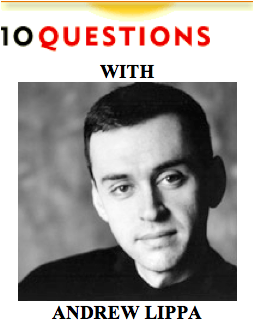
Fynsworth Alley: 10 Questions with Andrew Lippa

Originally published on Fynsworth Alley.

10 Questions with Andrew Lippa


How do you feel about being grouped as part of the much talked about “next generation” of Broadway writers?

I think the grouping of people comes from the needs of newspaper/column writers to give some kind of organization to things. Probably the only reason we are grouped together is that we’re a gang of people who have been consistently produced in New York. But, of course, that doesn’t account for people who’ve created some great stuff. Steven Trask (Hedwig) comes to mind as someone I haven’t read much about who wrote a great score. And I don’t think he’s included in that “next generation” stuff. Admittedly, it’s always nice to be talked about but there’s not much to the discussion other than pointing out that there ARE a group of really gifted younger writers who want to write musicals. That in itself is cause for celebration!

What’s your next writing project?

I’m writing several things right now. First is a new musical called Enchant with bookwriter Betsy Pool. I don’t really want to say what it’s about yet but it’s based on a screenplay by Betsy and it’s a very musical idea in that a lot of the characters sing by profession (though it’s not a backstage musical either). Curious? Well, once we’ve written a draft I’ll be a little more willing to talk about it. The other project is a movie called A Whatnot Christmas for which I am writing the songs and score. It is being directed and written by Mitchell Kriegman and will be released next year. It’s done with puppets and computer animation and I’m in the process of writing and recording the songs right now.

What’s your role in the upcoming Cinderella tour, and how did that come about?

I’m the musical supervisor and arranger for that tour. Gabriel Barre (who directed The Wild Party) is directing and asked if I would come on board. It’s been fun to work with such great music and to re-think it to fit into a new book and a new production. This is the first first-class production of this show so it’s got some excitement around it.   Continue reading