Camp vs. Kitsch: It’s a Bird, It’s a Plane…

Originally published on Camp vs. Kitsch.

Comic book movies have been so hot lately, it’s easy to forget that they haven’t always been so. But, like anything with devoted fans, even the acknowledged worst of the worst — in this case, that is undoubtedly Howard the Duck — have their staunch defenders. You have to understand, part of the horror of the Howard movie is that the comic book on which it is based is pretty much a work of genius. I know, if you’ve only ever seen the movie, that claim is hard to wrap your mind around. But it’s true. Don’t believe me? Go look. There’s a cheap, $15 “Essential Howard the Duck” paperback available now with most of the original Howard appearances all in one, black and white book. There’s also a hefty, hardcover color Howard Omnibus that’s worth checking out if you’re either loaded or a patron at a well-stocked library.

The film, which starred a punked up Lea Thompson and the voice of Broadway actor Chip Zien (better remembered as the Baker in the original cast of Into the Woods), has so many head-scratcher moments, but nothing tops the grand finale Howard the Duck musical number…

Sing it, Lea!
What could possibly go head to head with this unredeemable kitsch? It would be tempting to throw up a clip of the 60s Batman television show, particularly one with a deliciously camp guest star like Liberace or Ethel Merman. But since part of my mission here is to share some of my private Camp obsessions, I feel obligated instead to share a scene from It’s a Bird, It’s a Plane, It’s Superman, the musical based on the Man of Steel, from the songwriters who brought you Bye, Bye, Birdie. The show, which ran on Broadway for a few months in 1966, is nowadays remembered as a pretty entertaining campfest that unfortunately just missed the moment when campiness was in for superheroes.

For reasons that just don’t make any sense to me, the show was resurrected as a late night television movie in 1975, done on an incredibly low budget with horribly “updated” orchestrations. I haven’t seen the whole broadcast (although it’s on my list for a future trip to the Paley Center), but what I have seen is mostly disappointing because it sucks a lot of the fun out of the songs. (The original cast album of the Broadway production is a lot of fun.)

Anyway, I couldn’t find this number in its entirety on YouTube, but I think the clip of David Wilson singing “Pow! Bam! Zonk!” gives you enough of a taste of the show…

Pow! Bam! Zonk!

Survey ResultsGlowDay.com

The Anxiety of Aging: The Case of Wendy Moira Angela Darling

In the fall of 2002, I took a graduate-level class in developmental psychology with Prof. Joe Reimer at Brandeis. For one assignment, we were asked to write a case study of a fictional character. I chose Wendy, from the Peter Pan stories. 

The Darling family lived in a tidy English townhouse at 14 Kensington Gardens at the turn of the century.  The family consisted of parents George and Mary, elder daughter Wendy, sons John and Michael, as well as a dog called Nana and a servant named Liza.  Mrs. Darling made it a daily habit to spend a moment each evening after tucking her children in their beds to recollect what she had learned from each of her children that day, a process she referred to as “tidying up her children’s minds” (Barrie, 12; ch. 1).  As Wendy neared the onset of puberty, Mrs. Darling noticed during her tidying of her daughter’s mind that Wendy devoted more and more of her energy towards enacting fantasy stories involving the character of Peter Pan, a boy who lived with the fairies and wouldn’t grow up.  Although Mrs. Darling took note of her daughter’s increasing focus on her fantasy world, for the time being she dismissed any fears with the assurance that fantasy is a healthy aspect of childhood play.

Not long after she first took notice of her daughter’s new play-pattern, Mrs. Darling noted an alarming change in the way Wendy spoke of Peter Pan.  Rather than merely telling stories of Peter’s adventures in the “Neverland” of her dreams, Wendy began insisting that Peter periodically made nighttime visits to the nursery Wendy shared with her brothers.  Wendy’s alleged adventures followed the pattern Wendy had previously set in the bed-time stories she would tell her brothers.  The elements of Wendy’s stories were always the same:  meeting at night in the nursery, flight from the world of Wendy’s home, adventures involving childhood staple characters like mermaids and pirates, and Wendy assuming the role of mother to Peter and his “lost boys.”   Continue reading

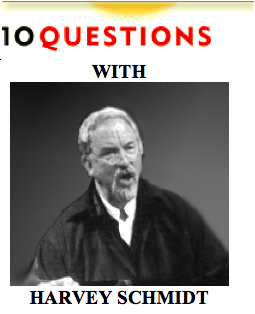
Fynsworth Alley: 10 Questions with Harvey Schmidt

Originally published on Fynsworth Alley.

10 Questions with Harvey Schmidt

What was your involvement in the film version of The Fantasticks?

After years of turning down offers, of waiting and hoping that some day, some film director would come our way with a vision that we might approve on just how to turn what is very much a stage piece into film, Michael Ritchie came along and presented us with such a proposal. So Tom and I were engaged to work on the screenplay and to also be on call for whenever Michael wanted us around, whether it be recording sessions, location shooting in Arizona, or final editing sessions in Los Angeles and New York.

Is there any truth to the rumored Broadway revival of I Do! I Do! with Kathie Lee Gifford?

Up till now I have only heard the same rumors that everyone else seems to have heard. Having long been a fan of hers, I think she could be a perfect “Agnes” in this show, so I would be delighted if the rumors should turn out to be true. Continue reading